

To build well-rounded, three-dimensional shoulders, training must account for the specific anatomy, regional subdivisions, and biomechanical functions of the deltoid muscle. Many lifters struggle to develop the side and posterior heads, resulting in shoulders that lack visual pop.
Understanding how the deltoid functions across various joint angles and ranges of motion allows for precise exercise selection and execution.
Want to take your training up a notch?
Use promo code SAVE10 to get 10% off any program right now. https://citizenathletics.com
Learn more about our training at the bottom.
Deltoid Anatomy: Origins, Insertions, and Regional Subdivisions
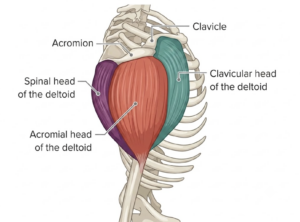
The deltoid (or delt) sits at the top of the shoulder. While technically a single muscle crossing the glenohumeral joint to insert into the deltoid tuberosity of the upper arm, it is functionally divided into three main heads based on distinct origin sites:
- Anterior Head: Originates on the lateral portion of the clavicle.
- Middle Head: Originates on the acromion process.
- Posterior Head: Originates on the spine of the scapula.
Biomechanical Functions and Muscle Overlap
Each deltoid head performs specific biomechanical actions:
- Anterior Deltoid: Performs shoulder flexion, horizontal adduction, and internal rotation, while contributing to abduction.
- Middle Deltoid: Performs primary shoulder abduction, with minor contributions to other movements such as flexion.
- Posterior Deltoid: Performs shoulder extension, horizontal abduction, and external rotation, while contributing to abduction.
The 7 Functional Subdivisions
While traditional programming categorizes the deltoid into three heads, research demonstrates that the muscle actually operates across seven distinct functional subdivisions:
- Anterior Deltoid: 1 subdivision
- Middle Deltoid: 2 subdivisions
- Posterior Deltoid: 4 subdivisions
This anatomical structure explains why the posterior deltoid requires a wider variety of angles and exercises compared to the anterior or middle deltoids.
Understanding Synergistic Muscle Involvement
Because other large muscle groups share these functional roles, exercise selection dictates which muscle receives the primary stimulus:
- Chest vs. Anterior Delt in Flexion: The pectoralis major assists in shoulder flexion during movements like the bench press. However, in an overhead shoulder press, once the weight passes the head, the pec becomes relatively inactive, forcing the anterior and middle deltoids to execute the remaining work.
- Lats vs. Posterior Delt in Extension: The latissimus dorsi acts as a powerful shoulder extensor at lower ranges of shoulder flexion but loses mechanical leverage at higher ranges. The posterior deltoid maintains significant force production capacity at high ranges of shoulder flexion when bringing the arm down (e.g., in pullovers, dead hang pull-ups, or dead hang lat pulldowns).
- Shoulder Abduction Overlap: Shoulder abduction is shared among the middle delt, anterior delt, supraspinatus, and trapezius. Specific execution cues are required to bias loading onto the middle delt.
Training the Anterior Deltoid: Why Isolation Work Is Unnecessary
While front raise variations are common, research repeatedly shows that compound pressing movements stimulate the anterior deltoid far more effectively.
The fiber orientation of the anterior delt allows it to be heavily loaded through horizontal and vertical pressing movements, including:
- Barbell or dumbbell bench presses
- Overhead shoulder presses
- Push-ups
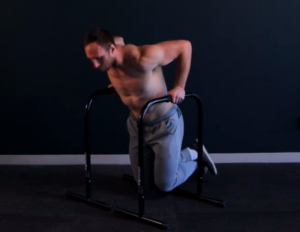
- Dips
Key Takeaway: If a training program includes 10 to 20 total pressing sets per week, direct anterior deltoid isolation work is unnecessary.
Training the Middle Deltoid: The 5 Rules of the Lateral Raise
While shifting to a more lateral elbow position during overhead pressing can slightly bias the middle deltoid, pressing alone will not maximize its development. Research consistently confirms that the lateral raise outperforms almost every other exercise for middle deltoid activation.
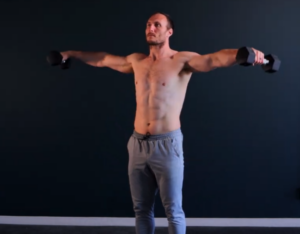
To maximize middle deltoid recruitment during a lateral raise, follow these 5 technical rules:
- Keep the Arm Straight: Excessive elbow bending shifts the load away from the middle deltoid toward the anterior deltoid and rotator cuff musculature.
- Orient the Thumb Down or Palm Flat: Internally rotating the arm (thumb down) or keeping the palm flat lines up the middle deltoid fibers along the path of resistance. Pointing the thumb up shifts loading to the anterior deltoid.
- Raise Arms Straight to the Side: Raising the arms forward into the scapular plane shifts tension toward the supraspinatus or anterior deltoid.
- Maintain a Slight Forward Lean: A slight forward tilt aligns the middle deltoid origin and insertion against gravity, taking load off the front delt. Using a chest-supported incline bench provides stability to experiment with optimal angles.
- Reach Out, Not Up: Focus on pushing the hands outward toward the walls rather than shrugging upward. Shrugging engages the upper trapezius via scapular elevation, reducing targeted tension on the deltoid.
Optimizing Lateral Raise Variations
Dumbbells vs. Cables
- Dumbbell Lateral Raise: Provides minimal mechanical resistance during the first 45° to 60° of movement, placing most of the load near the top.
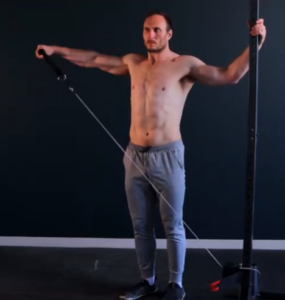
- Cable Lateral Raise: Maintains direct tension from the start of the movement through a greater range of motion, yielding an even resistance profile that favors long-term hypertrophy. Using a split stance helps align the cable path directly with the middle deltoid fibers.
The Leaning-Away Lateral Raise
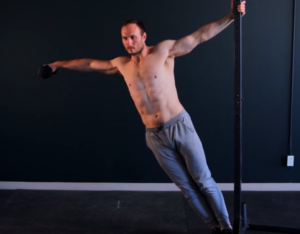
The supraspinatus is typically most active during the initiation of shoulder abduction. By leaning away from the anchor point (using cables or dumbbells), the angle of resistance changes, loading the middle deltoid more effectively while minimizing early supraspinatus dominance.
Working Height and Full Range of Motion
Stopping lateral raises strictly at shoulder height is unnecessary:
- In side-lying or leaning variations, the arm naturally travels past shoulder height until perpendicular to the torso.
- Incorporating full-range overhead lateral raises (sometimes called butterfly lateral raises) introduces high-range challenge and movement variety to drive muscle growth.
Training the Posterior Deltoid: Compound Adjustments and Isolation
Like the anterior head, the posterior deltoid contributes to compound pulling movements (rows, pull-ups, pulldowns). However, standard execution heavily targets the lats, rhomboids, and trapezius.
To bias compound pulls for the posterior deltoid, apply two mechanical adjustments:
- Flare the Elbows Higher: Abducting the arms to a wider angle reduces the latissimus dorsi’s ability to generate force during extension.
- Minimize Scapular Retraction: Focus on pulling the elbows back without aggressively squeezing the shoulder blades together. This limits trapezius and rhomboid recruitment.
Top Compound Rows for Rear Delts
- Wide-Angle Chest-Supported Row (Helms Row Variation): Lying face down on a flat bench eliminates lower back stress. Allow the shoulders to wrap around the bench at the bottom, then pull wide with flared elbows while minimizing scapular squeezing.
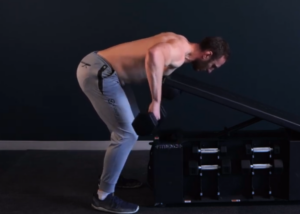
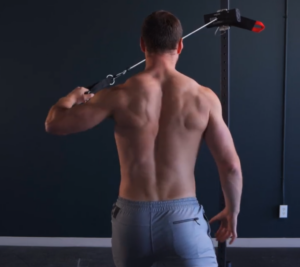
- Single-Arm High-to-Low Cross Row: Pulling from a high-to-low cable angle directly aligns resistance with the diagonal fiber path of the posterior deltoid. Performing this unilaterally eliminates arm crossover interference.
Rear Delt Isolation Exercises
While the reverse pec deck machine remains a primary standard for isolation, alternative movements provide equal or superior targeted loading:
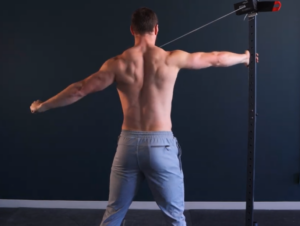
- Cross-Body Cable Reverse Fly: Sets up a high-to-low diagonal resistance line that isolates posterior deltoid horizontal abduction under continuous cable tension.
- Bent-Over or Chest-Supported Dumbbell Reverse Fly: Effectively loads the posterior deltoid, though peak tension occurs strictly at the shortened top range of motion.

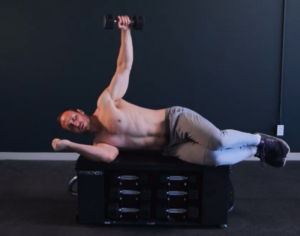
- Side-Lying Rear Delt Raise: Performed lying sideways on a bench with a dumbbell. Unlike the standing bent-over fly, this variation places maximum resistance on the posterior deltoid in its lengthened position at the bottom of the movement.
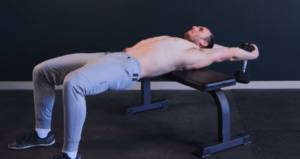
- Full-Range Pullover: Excellent for targeting specific upper subdivisions of the posterior deltoid. At the top end of the pullover movement range, back muscles lose leverage, requiring the posterior deltoid to pull the arm downward.
Summary Checklist for Deltoid Programming
- Anterior Deltoid: Skip direct front raise isolation if already completing 10–20 weekly compound pressing sets (bench press, overhead press, dips).
- Middle Deltoid: Direct lateral raises are essential. Prioritize cables over dumbbells, maintain straight arms with a slight forward lean, point thumbs down/palms flat, and reach outward.
- Posterior Deltoid: Modify rows by flaring elbows high and limiting scapular squeeze. Supplement with cross-body cable flies, side-lying dumbbell raises, and full-range pullovers to cover all four subdivisions.
Take Your Training to the Next Level
Looking for science-backed programs designed to optimize every variable of your training? Check out our complete line of evidence-based training programs at Citizen Athletics and start building strength with precision today.
- Built for Athletics: Our premium training system engineered to optimize raw strength, power, and high-level movement efficiency.
- Sustainable Strength: The ultimate flagship framework designed for busy individuals looking to lift heavy, build muscle, and remain highly athletic for life.
Watch the Full Scientific Breakdown

Want to see these exercise executions, biomechanical demonstrations, and fiber alignments in real time? Watch the full video here.