

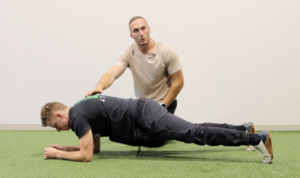
The plank is one of the most widely used core exercises in fitness, primarily challenging the anterior abdominal muscles.
While holding a plank, the goal is to maintain position and resist movement across multiple joints simultaneously: the spine, shoulders, hips, and knees. Mechanically, the plank is an isometric exercise. That means the entire objective is to resist motion rather than generate it.
Want to take your training up a notch?
Use promo code SAVE10 to get 10% off any program right now. https://citizenathletics.com
Learn more about our training at the bottom.
What Muscles Does the Plank Actually Work?
To understand what muscles are actively working during an isometric movement, you have to examine which joint motions you are actively resisting under load:
- Spine (Lower Back): You are resisting spinal extension (preventing the back from arching and the stomach from sinking down). This demands active recruitment of the spinal flexors (abdominals).
- Hips: You are stopping the hips from sinking into hip extension. This requires isometric hip flexion, working the hip flexors.
- Knees: You are preventing the knees from dropping into flexion. Resisting knee flexion works the knee extensors (quadriceps).
- Shoulders: You are stopping the chest from sinking down and the shoulder blades from collapsing together. Actively spreading the shoulder blades trains the shoulder protractors, specifically the serratus anterior.
- Neck: You are resisting the chin from dropping toward the ground. Tucking the chin back engages the neck retractors.
Overall, the plank heavily challenges the abs, obliques, quadriceps, and during more demanding variations, the shoulders.
What the Plank Does NOT Work
The plank is frequently promoted as a fix-all movement for the entire posterior chain, but biomechanically, that claim does not hold up:
- The Lower Back: Back muscles perform spinal extension. Because the plank forces you to resist extension by working your flexors, it does not challenge the lower back extensors.
- The Upper Back: Training the mid-and-upper back requires pulling movements like rows and pull-ups where the scapulae retract (come together). The plank requires protraction (pushing shoulder blades apart), which is the exact opposite movement.
- The Glutes: While actively squeezing the glutes is useful in a plank to help encourage a posterior pelvic tilt (which places the abdominals in a more advantageous position to work), the plank is not an effective glute builder. True glute training demands resisted hip extension against gravity (such as squats and hip thrusts). In a horizontal plank, gravity is actually assisting the glutes rather than loading them.
Common Plank Mistakes and How to Correct Them
Even though a standard plank looks straightforward, small technical breakdowns significantly decrease abdominal recruitment.
1. Excessive Lower Back Arching (Lordosis)
- The Error: Allowing the belly to sag toward the floor while the butt sticks up in the air.
- The Correction: Flatten out the lower back to maximize tension on the abdominal wall.
2. Excessive Spinal Rounding
- The Error: Rounding excessively through the upper and middle back.
- The Correction: Lower the hips slightly and keep a more natural spinal curve.
3. Sinking Hips
- The Error: Letting the hips sag toward the ground below the line of the torso.
- The Correction: Bring the pelvis up to form a straight line, which restores the full loading demand to the abdominals.
4. Piking the Hips Too High
- The Error: Elevating the hips high into the air.
- The Correction: Drop the hips back down until the shoulders, hips, and knees align. High hips shift the work away from the abs and place it onto the hip flexors.
5. Dropping the Head Down
- The Error: Letting the head hang completely relaxed toward the floor.
- The Correction: Maintain active recruitment through the neck retractors and scapular muscles to keep the spine aligned.
6. Looking Up Toward the Ceiling
- The Error: Hyperextending the neck to look forward or up at the ceiling, often creating neck discomfort.
- The Correction: Fix your eyes directly down at your hands.
7. Collapsing the Shoulder Blades
- The Error: Hanging passively on the shoulder joints so the shoulder blades pinch together.
- The Correction: Push through the forearms to spread the shoulder blades apart, actively engaging the protractor musculature.
8. Setting the Elbows Too Far Back
- The Error: Placing the forearms and elbows low down toward the hips, turning the movement into a modified push-up position that fatigues the triceps and shoulders prematurely.
- The Correction: Stack the elbows directly underneath the shoulders.
Programming: Hold Times and Training Frequency
How long and how often you should hold a plank comes down to your primary adaptation goal:
- Strength Focus: Select a variation difficult enough that you can only hold it for a maximum of 30 seconds.
- Endurance Focus: Choose a variation you can sustain for up to 60 seconds.
Training Frequency
How often you perform planks depends on your overall program:
- If your training already consists of heavy compound movements that challenge trunk stability to a high degree, planks are merely an optional accessory movement rather than a necessity.
- If your direct goal is targeted anti-extension core strength, perform 2 to 4 sets, 1 to 2 days per week.
Plank Regressions
If you cannot hit your target hold duration (such as 60 seconds) without your form deteriorating, you should regress the movement rather than perform it with poor technique.
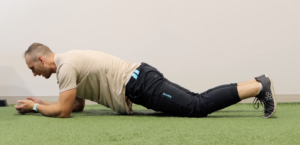
- Knee Plank: Lower your knees to the ground from the standard setup. This shortens the lever arm, reduces abdominal demand, and allows you to build baseline capacity.
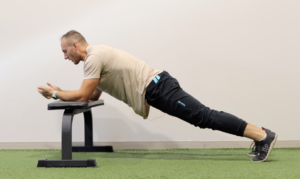
- Elevated Arm Plank: Place your forearms on an elevated surface such as a bench. This changes the angle of load, decreasing the effort required so you can maintain strict technical control over longer intervals.
Plank Progressions
Once you can comfortably hit standard hold times with strict alignment, increase the difficulty using these progressive overload strategies:
- Extended Lever (Long-Lever Plank): Set up in a regular plank, then move your elbows forward so they sit directly underneath your eyes or further. Lengthening the lever arm dramatically ramps up the demand on your anterior core.
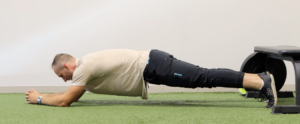
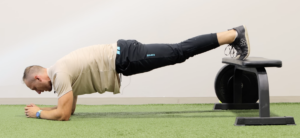
- Elevating the Feet: Place your feet on a bench or elevated surface while keeping your forearms on the floor. The change in body angle increases loading on the abdominals without requiring complex movement.
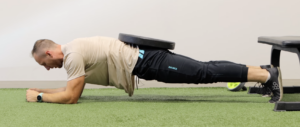
- External Loading (Weighted Plank): Maintain standard plank positioning and place a weight plate flat on your back. This directly increases the resistance your spinal flexors must fight to stop your lower back from sinking into extension.
- Body Saws: Set up in a plank and actively rock your entire body forward and backward. This can also be performed with feet on sliding discs. Every time you slide backward, the lever arm extends, recruiting the lats alongside the core.
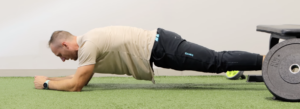
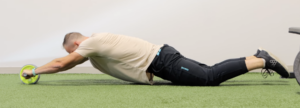
- Ab Wheel Rollouts: Performed with straight arms moving dynamic loads, rollouts function as a dynamic progression of the plank. They heavily challenge your ability to resist spinal extension throughout a full range of extremity motion.
Upgrade Your Core Training with Citizen Athletics
Mastering fundamental mechanics is the difference between wasting energy and building real, transferrable strength. If you want structured, evidence-based strength and conditioning built around proven training principles, explore our training programs at Citizen Athletics:
- Built for Athletics: Our premium training system engineered to optimize raw strength, power, and high-level movement efficiency.
- Sustainable Strength: The ultimate flagship framework designed for busy individuals looking to lift heavy, build muscle, and remain highly athletic for life.
Watch the Scientific Breakdown
To see each of these technical cues, common errors, and progressive exercises demonstrated in real time, watch the full breakdown here.