

The landmine setup, fixing one end of a barbell to an anchor point while leaving the other end free to move, is a versatile training tool. It provides added stability compared to free weight movements and introduces a unique arcing movement path. This angled trajectory allows for different muscle loading patterns, altered angles of resistance, and enhanced muscle engagement across various movement planes.
Want to take your training up a notch?
Use promo code SAVE10 to get 10% off any program right now. https://citizenathletics.com
Learn more about our training at the bottom.
Understanding the Landmine Mechanics
A landmine anchor locks one end of a standard barbell in place (either in a dedicated attachment, a corner, or between heavy dumbbells), leaving the opposite end free to move in a multidirectional arc.
Key Training Advantages
- Increased Stability: Having one end fixed reduces stability demands compared to open-chain dumbbell or barbell movements, allowing higher force output.
- Unique Arcing Motion: The natural arc changes the leverage and line of pull, offering distinct training angles for target muscle groups.
- Enhanced Muscle Recruitment: The altered resistance curve facilitates better mind-muscle connection and target muscle isolation across strength, power, hypertrophy, and endurance applications.
Lower Body and Multi-Planar Variations
1. Landmine Goblet Squat
- Execution: Hold the end of the barbell at chest height with both hands.
- Foot Positioning: Position the feet so the balls of the feet align roughly with the edges of the barbell plate on the ground.
- Quad vs. Hip Dominance: Lean forward into the landmine to create a quad-dominant squat pattern. To make the movement more hip-dominant, stand closer to the attachment point and shift the hips further back.
2. Goblet Reverse Lunge
- Set up in a goblet grip at chest height, using a slightly narrower stance than the standard landmine squat.
- Step backward into a controlled reverse lunge while maintaining an upright posture.
3. Reverse Lunge (Side Grip)
- Hold the barbell down at your side with one hand (similar to holding a dumbbell).
- This allows for higher absolute loading of the leg muscles.
- Tip: Use a lifting strap to eliminate grip strength limitations when loading heavier weight.
4. Skater Squat
- Hold the barbell at chest height in a goblet position.
- Step one leg back into a single-leg squat without allowing the rear foot to touch the ground.
- Lower until the rear knee gently touches a foam pad, then press back up into the working leg. The fixed anchor point provides stability to drive backward and upward out of the bottom position.
5. Goblet Lateral Squat
- Adopt a wide stance perpendicular to the barbell trajectory.
- Shift weight to one side, sitting down into the working hip while keeping the opposite leg straight.
- Targets the adductors and glutes within the frontal plane.
6. Curtsy Lunge
- Position the body perpendicular (sideways) to the landmine attachment for superior movement mechanics.
- Cross the rear leg behind the front leg to lower into a lunge.
- Heavily engages the glutes and benefits athletes (such as hockey players) who require multi-planar crossover strength.
Dynamic, Rotational, and Combination Exercises
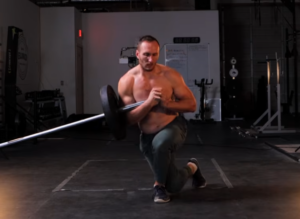
7. Lunge to Press
- Hold the barbell in a single-arm rack position.
- Perform a reverse lunge, then drive forward and explosively press the bar overhead as you return to the standing position.
- Excellent for metabolic conditioning blocks.
8. Landmine Thruster
- Hold the barbell with two hands at chest level.
- Sink into a full squat and immediately transition into an overhead press at the top of the movement.
9. Rotational Squat to Press
- Stand perpendicular to the landmine setup, holding the end of the bar with your outside arm.
- Squat down, then explosively rotate through the hips, pivot the feet, and press the bar overhead.
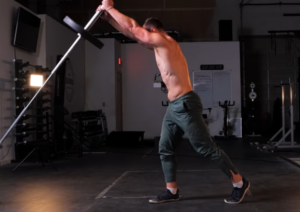
10. Rotational Lift to Press
- Lower the bar dynamic-style down toward the floor, rotate through the torso, and press upward.
- Can be executed holding with two hands for stability or by switching hands mid-rotation during the movement.
Upper Body Pulling Variations
11. T-Bar Row
- Stand over the bar and pull the weighted end toward the chest using a neutral double-handle grip. A classic upper-body pulling exercise.
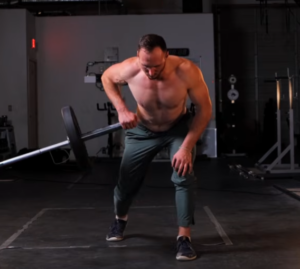
12. One-Arm Landmine Row
- Stand parallel to the bar and pull the sleeve up with one arm.
- Limitation: Standard weight plates can collide with the torso at the top, restricting full range of motion.
13. Perpendicular Row
- Stand perpendicular to the barbell shaft.
- Pull the bar up along the side of the torso without plate interference.
- The arcing motion pulls outward, heavily recruiting the upper back, posterior deltoids, and scapular stabilizers.
Core Rotational and Explosive Power Exercises
14. Standing Landmine Twist
- Hold the barbell extended in front with straight arms.
- Rotate the bar side-to-side down to thigh height, pivoting the feet with each turn while keeping the arms extended.
15. Twist and Lunge
- Lower the barbell all the way down to the floor on one side while dropping into a lunge.
- Sweep the bar upward in an arc overhead and sink into a lunge on the opposite side. Arms can bend slightly at the top of the arc to maintain control.
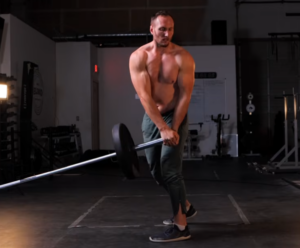
16. Landmine Snatch
- Stand perpendicular to the bar, grab the end with one hand, and explosively pull and punch the bar overhead.
- Requires significantly less technical mastery than a traditional barbell snatch because the weight arcs freely alongside the body.
Posterior Chain Variations
17. Romanian Deadlift (RDL)
- Hold the bar in front of the hips and hinge back.
- The angled path encourages a posterior hip shift, heavily loading the glutes and hamstrings while reducing unwanted lower-back shear forces.
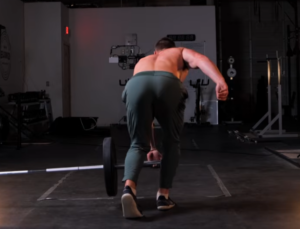
18. Single-Leg Landmine RDL (Linear)
- Hinge on one leg while the non-working leg extends backward into space.
19. Perpendicular Single-Leg Landmine RDL
- Perform the hinge facing perpendicular to the bar.
- The arcing motion sweeps across the body, adding a rotational component that forces the glutes to stabilize and pull harder out of the bottom position.
20. Staggered Perpendicular Single-Leg RDL
- Keep the non-working foot on the ground in a kickstand position close to the front foot.
- Reduces balance demands while maintaining targeted glute and hamstring tension.
Overhead and Horizontal Pressing Variations
21. Standing One-Arm Landmine Press
- Functions as a hybrid between a horizontal and true overhead press due to the arcing trajectory.
- Easier on sensitive shoulders than strict vertical overhead pressing.
22. Half-Kneeling One-Arm Landmine Press
- Perform the press with one knee on the floor.
- Allows the lifter to lean forward at the top of the movement to safely grade exposure to full overhead shoulder flexion.
23. Alternating Press TK
- Maintain a double-knee tall-kneeling posture, pressing the bar up and alternating hands at the top for power development.
24. One-Arm Press Squat Hold
- Maintain the bottom position of an isometric squat while completing a single-arm press overhead.
25. Alternating Press Squat Hold
- Hold an isometric squat at parallel while dynamically switching and pressing the bar from side to side.
26. Z Press
- Sit flat on the floor with legs extended in an upright posture and press overhead.
- Requires maximum abdominal contraction to prevent leaning backward.
27. Sit-Up to One-Arm Press
- Perform a full sit-up off the floor, finishing directly at the top with a single-arm Z press. Excellent dynamic trunk challenge.
28. Russian Twist
- Sit on the floor facing the anchor point with feet elevated.
- Rotate the barbell side to side across the torso.
29. Landmine Push Press
- Use a subtle leg dip and drive to press the weight overhead. Can be performed with symmetrical feet or a slight staggered stance for better hip support.
30. Landmine Push Jerk
- Dip and explosively drive the bar overhead while dropping under the weight. Offers power benefits without requiring complex Olympic lifting technique.
31. Landmine Split Jerk
- Drive the bar overhead while dropping into a split stance posture. Highly effective for athletes needing explosive triple extension and force transfer.
32. Anti-Rotational Twists (Standing)
- Sweep the bar side-to-side in front of the body while keeping the chest locked directly toward the anchor point.
- Resists trunk rotation to isolate core stability. Can be performed in standing, half-kneeling, or isometric squat positions.
33. Anti-Rotational Twists HK
- Execute the anti-rotational sweep from a half-kneeling position to heighten core challenge.
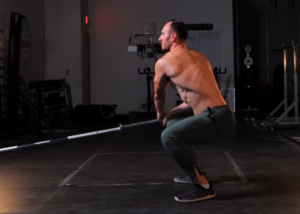
34. Anti-Rotational Twists Squat Hold
- Perform anti-rotational core sweeps while holding an isometric squat hold.
Isolation and Hypertrophy Movements
35. Landmine Lateral Raise
- Arc the bar upward and outward across the body.
- Passes through anterior, lateral, and posterior paths to target all three heads of the deltoid in a single fluid movement.
36. Quadruped Landmine Kickback
- Start on all fours with the barbell tucked behind the crease of the knee.
- Kick the heel up and back to target the glutes and hamstrings.
37. Single-Leg Landmine Hip Thrust
- Position the barbell across the pelvis for a single-leg thrust.
- The asymmetrical load forces the core and hip rotators to resist rotation during extension.
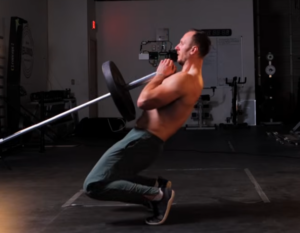
38. Landmine Hack Squat
- Lean your upper back directly against the padded end of the barbell and perform a squat to isolate the quadriceps.
39. Facing Anchor Sissy Squat
- Face the anchor point, hold the bar, and lean back into knee flexion to overload the quads and core.
40. Landmine Standing Calf Raise
- Lean forward into the bar and perform calf raises on a stable surface. The forward-angled vector allows for continuous tension throughout the drive phase.
How to Properly Set Up a Landmine Station
Setting up your equipment correctly protects your gym environment and ensures proper movement mechanics.
Setup Options
- Bare Barbell in a Corner (Not Recommended): Placing the end of a barbell directly into a wall corner can easily scuff or damage drywall as the bar rotates.
- Towel-Wrapped Corner Setup: Wrapping the end of the barbell in a thick towel offers basic wall protection, though it remains a temporary fix.
- Dedicated Landmine Attachment (Optimal): Utilizing a floor plate, plate-loaded sleeve, or power-rack attachment. These are inexpensive, durable, and afford 360-degree rotation.
- Dumbbell Anchor Setup: Place two heavy, rubber-coated dumbbells together on the floor at an angle to create a snug “V” wedge for the barbell sleeve.
Ready to Elevate Your Training?
If you want structured, science-backed programming that incorporates these variations effectively into your routine, explore our comprehensive workout options at Citizen Athletics. Take the guesswork out of your progression and start training smarter today.
- Built for Athletics: Our premium training system engineered to optimize raw strength, power, and high-level movement efficiency.
- Sustainable Strength: The ultimate flagship framework designed for busy individuals looking to lift heavy, build muscle, and remain highly athletic for life.
Watch the Visual Exercise Guide
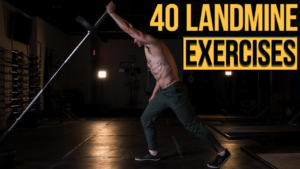
Prefer a visual demonstration of these movements and setup options to see proper form, execution cues, and setup strategies? Watch the full video breakdown here.