

Training your glutes has become a massive focus across the fitness industry. Lifters have shifted from generic lower-body training to heavily emphasizing glute-specific work.
While emphasizing the glutes is not inherently a problem, the way people implement glute training is often completely incorrect. The most widespread offender is the ubiquitous “booty band” (or glute loop). If your primary goal is maximizing glute growth, slapping an elastic band around your knees might be the exact thing holding you back.
Want to take your training up a notch?
Use promo code SAVE10 to get 10% off any program right now. https://citizenathletics.com
Learn more about our training at the bottom.
What Booty Bands Actually Are and How They Work
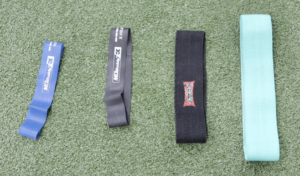
A booty band or loop is an elastic resistance tool designed to challenge movement through variable tension.
- Physical varieties: They come in different shapes, sizes, materials, and colors.
- Resistance options: Historically, bands came only in single, fixed resistances, but options offering a range of resistances are now available.
- Mechanism: They add an increased challenge to lower-body exercises solely through elastic resistance.
How People Commonly Use Bands, And Where the Logic Fails
1. Warm-Ups and Glute “Activation”
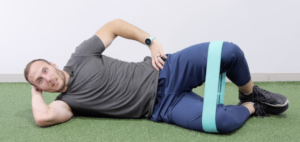
Many trainees place a band around their knees during warm-up movements, such as glute bridges, lateral walks, abductions, and clamshells, hoping to “activate” their glutes before lifting.
While adding a band can increase glute recruitment during these warm-ups, it only does so because it increases the overall resistance of the movement. This effect is not unique to bands:
- Performing a bodyweight squat recruits a baseline amount of glute muscle.
- Performing a goblet squat increases glute activation simply because external load was added.
Adding resistance increases demand; the band itself possesses no special activation power.
2. Main Lifts and Compound Work
Trainees frequently add bands directly into their primary working sets for exercises such as:
- Squats
- Hip thrusts
- Jumping
- Running
While the idea of adding resistance to challenge the glutes seems logical on the surface, you must evaluate the primary role of the glutes in that specific movement. If the elastic loop interferes with or takes away from that primary job, it negates the real benefit of the exercise.
Analyzing Compound Lifts: Hip Thrusts vs. Squats
Understanding when an elastic band is helpful versus when it is counterproductive comes down to the mechanics of the movement.
The Hip Thrust: Where Bands Can Work
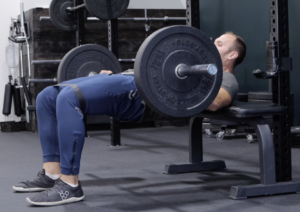
- Primary function: Emphasizes hip extension, with the hardest point of the movement occurring at the top near full lockout.
- Biomechanical demand: At lockout, there is minimal demand on hip abduction or external rotation.
- Application: Adding a band around the knees to maintain alignment while driving through hip extension is a reasonable option, provided the resistance is manageable.
The Squat: Why Bands Ruin the Movement
- Primary function and depth: Unlike the hip thrust, the squat places minimal challenge on the glutes at full hip extension (standing). The glutes experience the greatest demand deep in hip flexion at the bottom of the squat.
- The hypertrophy evidence: Research demonstrates that deeper squatting produces superior muscle growth in the glutes. Achieving full depth must be the priority.
- The problem with bands: Bands frequently pull trainees out of position, causing them to cut depth into quarter- or half-squats instead of reaching the deep ranges required for muscle growth.
- The “knees out” cue backfires: While some theorize that bands cue lifters to push their knees out against the resistance, the primary task of the squat is to descend and stand back up via hip extension. Fighting inward band tension creates an irrelevant challenge. Studies show that squatting with a band around the knees actually increases knee adduction (inward collapse) compared to squatting without one.
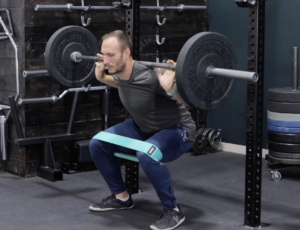
The takeaway: If glute growth is your goal on squats, ditch the band, put more weight on the barbell, and focus on achieving full depth.
The Trap of Going Too Heavy on Hip Thrusts
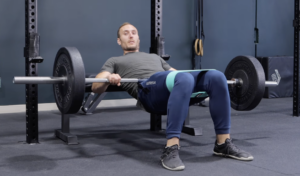
Even on exercises where bands are technically viable, such as hip thrusts, lifters frequently overdo the resistance:
- Instead of using a light, manageable loop, trainees choose heavy, aggressive bands.
- High band tension forces the knees inward, preventing the lifter from maintaining proper alignment.
- The lifter spends the entire set fighting lateral tension rather than achieving full hip extension and lockout at the top.
When lateral resistance overpowers the movement, you sacrifice the primary objective of the lift.
Jumping and Running: When Bands Ruin Movement Quality
Not every lower-body exercise is meant to be an isolated glute builder. Even when the glutes are active, they may not be the focal point of the drill.
Jumps
- Primary objective: Speed and power output.
- The band issue: Fighting lateral tension so your knees don’t collapse does not transfer into greater power once the band is removed.
Running
- Trainees sometimes run with a band around their knees expecting greater glute recruitment.
- While it may provide resistance during the push-back phase, it directly resists hip flexion (bringing the leg forward).
- Resisting hip flexion shortens your stride length and disrupts running mechanics.
- Better alternatives: To develop push-off mechanics, focus on running velocity, increasing stride length, distance, or utilizing a waist-anchored resistance band rather than a knee loop.
The Right Way to Use Booty Bands: Direct Abduction and External Rotation
Booty bands excel when the resistance matches the specific plane of motion you want to train.
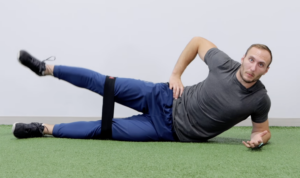
Rather than forcing them onto compound hip extension lifts, use bands for direct, isolated work targeting hip abduction and external rotation:
- Side-lying hip abductions
- Clamshells
- Targeted seated or standing hip abductions
When your objective is targeting abduction and external rotation, using a band that works directly against those movement paths is both intelligent and effective.
Summary Guidelines for Glute Training
- Compound lifts (Squats, Hip Thrusts): Focus on progressive overload, add more weight to the bar, increase reps, achieve full depth, and hit complete lockout.
- The gray zone (Banded Hip Thrusts/Bridges): If you incorporate a band for additional abduction demand, use a light resistance that allows clean mechanics, full extension, and zero knee collapse.
- Direct hip work (Abductions, Clamshells): Use elastic bands to directly challenge abduction and external rotation.
Level Up Your Training with Citizen Athletics
Building real muscle and strength requires evidence-based programming, progressive overload, and proper biomechanics, not social media fitness fads.
Explore our structured training programs at Citizen Athletics to take the guesswork out of your lifting and start making measurable, science-backed progress.
- Built for Athletics: Our premium training system engineered to optimize raw strength, power, and high-level movement efficiency.
- Sustainable Strength: The ultimate flagship framework designed for busy individuals looking to lift heavy, build muscle, and remain highly athletic for life.
Watch the Scientific Breakdown
To see these biomechanical demonstrations and visual comparisons in detail, watch the full video here.