

The calves are a muscle group that many lifters struggle to grow, often believing that regardless of effort, development is impossible. However, most people make key programming and execution mistakes that severely limit calf hypertrophy.
To correct this, you must understand calf anatomy, regional differences, biomechanical functions, length-tension relationships, and how joint angles dictate muscle recruitment.
Want to take your training up a notch?
Use promo code SAVE10 to get 10% off any program right now. https://citizenathletics.com
Learn more about our training at the bottom.
Calf Anatomy and Biomechanical Function
While the calf complex comprises several muscles, the two most prominent are the gastrocnemius and the soleus:
- Gastrocnemius: Consists of two heads, one medial (inner) and one lateral (outer). Both heads originate just above either side of the back of the knee, cross down, and merge with the soleus to attach to the calcaneus (heel bone) via the Achilles tendon. The gastroc is the superficial muscle covering the deeper tissue.
- Soleus: Originates on the posterior side of the tibia and fibula, sitting directly underneath the gastrocnemius before merging into the Achilles tendon.
Primary Functions and Joint Mechanics
- Plantarflexion: Due to their attachment onto the heel bone, both the gastrocnemius and the soleus perform plantarflexion (pointing the foot downward, similar to pressing down on a gas pedal).
- Knee Flexion: Because the gastrocnemius crosses the posterior knee joint, it also acts as an assistant knee flexor. The soleus does not cross the knee joint and acts exclusively on the ankle.
Why the Soleus Needs More Attention
Because the gastrocnemius crosses the knee joint, its ability to produce force decreases as knee flexion increases. When the knee bends to deeper angles, specifically 60 degrees of knee flexion or more, the gastroc enters active insufficiency, shifting the mechanical demand directly onto the soleus.
Targeting the soleus is essential for two reasons:
- Actual Size: While the gastrocnemius receives the most attention because it sits on the surface, the soleus actually makes up significantly more total muscular volume.
- Visual Impact: A well-developed, powerful soleus physically pushes the gastrocnemius outward, creating a substantially larger, more defined calf profile.
Note on the Soleus:
The soleus does get stimulated effectively when the knee is extended and it is not mandatory to train with a bent knee to target it. However, there is research suggesting a bent knee stimulates it differently and can be a beneficial option to have in the rotation.
Preferencing the Medial vs. Lateral Heads (Foot Position)
Manipulating foot orientation can isolate and emphasize the different heads of the gastrocnemius:
- Historically, research was limited to short-term EMG studies that yielded mixed conclusions.
- A 9-week training study by Nunes et al. (2020) evaluated calf training three times per week with varying foot rotations:
- Toes Pointed Out: Produced significantly greater hypertrophy in the medial gastrocnemius.
- Toes Pointed In: Produced significantly greater hypertrophy in the lateral gastrocnemius.
- Toes Pointed Forward: Provided balanced recruitment across both heads.
If you have a lagging inner or outer calf head, adjust your toe angle accordingly during straight-leg movements.
Straight-Knee Exercises: Maximizing Gastrocnemius Growth
Keeping the knee extended places the gastrocnemius on stretch, enabling it to contribute maximally to ankle plantarflexion.
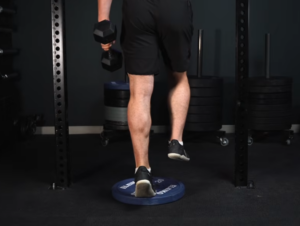
1. Deficit Single-Leg Calf Raise
- Setup & Balance: Stand on a platform or block on one leg. Always hold onto a sturdy upright so balance does not limit your force production.
- Range of Motion: Use a deficit to sink into a deep stretch at the bottom of the movement.
- Technique:
- Add a solid pause at the bottom of each repetition to dissipate the stretch reflex and elastic response of the Achilles tendon, shifting the load directly onto the muscle fibers.
- Pause briefly at the top to confirm you are achieving true full range of motion.
- Loading & Volume: Train with higher rep ranges (8 to 30 reps) to target the predominantly slow-twitch fibers of the lower leg. Add load via a weight vest, dumbbell, or available resistance.
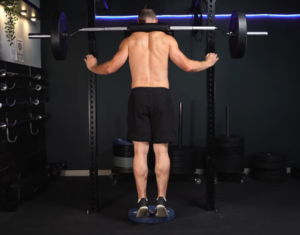
2. Standing Deficit Calf Raise (Bilateral)
- Execution: Perform bilaterally on a deficit with the same disciplined pauses at the bottom and top.
- Loading Strategy: Because this variation is bilateral and extremely stable, use heavy loads in lower rep ranges (5 to 10 reps) to recruit stronger, fast-twitch motor units.
- Equipment Options:
- Standing Calf Raise or Donkey Calf Raise Machine: Ideal for stable loading.
- Safety Squat Bar: Allows heavy loading while leaving your hands free to grip the rack uprights for balance.
- Dip Belt: Excellent alternative for loading heavy weight through the hips while holding uprights.
- Barbell or Dumbbells (Flat Ground Only): If you only have standard free weights and cannot hold onto a support, execute the movement on flat ground to avoid falling or rocking uncontrollably on a deficit block.
Bent-Knee Exercises: Maximizing Soleus Hypertrophy
Bending the knee to at least 60 degrees reduces gastrocnemius involvement and emphasizes the soleus.
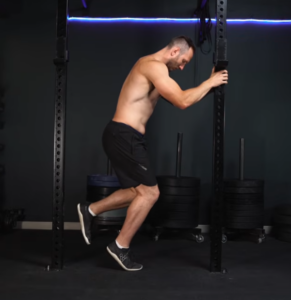
1. Single-Leg Soleus Raise
- Setup: Stand on one foot while holding onto a stable structure.
- Knee Angle: Bend your working knee to at least 60 degrees of knee flexion and maintain that exact angle throughout the entire set.
- Cues: Keep your knee driven forward over the foot. Move your entire torso and hip system as a single unit, do not extend or stand up through the knee on each rep.
- Execution & Loading: Pause at the bottom of every rep to remove the stretch reflex. Target higher rep ranges. If body weight is insufficient, add resistance using a dumbbell, resistance bands, or a weighted vest.
2. Seated Calf Raise
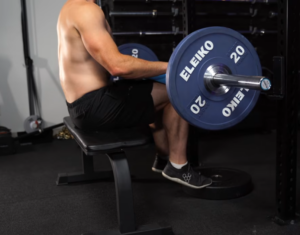
The seated calf raise is the premier movement for loading the soleus heavily in a stabilized position:
- Rep Ranges: Use lower rep ranges to challenge the fast-twitch fibers within the deep calf complex.
- Setup Options:
- Seated Calf Raise Machine: The optimal choice for direct loading and full range of motion.
- Barbell Across the Lap: Place a pad across your lap to cushion a heavy barbell, and elevate your toes on a block or plate to achieve a full deficit stretch.
- Heavy Dumbbells: Position dumbbells on your knees using a pad, elevating your toes for range of motion.
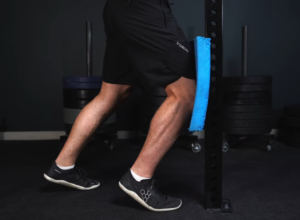
- Bodyweight/Isometric Alternative (Wall Knee-Drive): If you lack external weights:
- Stand facing a wall or rack post, positioning your foot roughly one foot away.
- Place a pad between your knee and the wall at knee height.
- Drive your knee forward, come up onto your toes, and push your knee forward through the pad as hard as possible.
- Perform either intermittent hard drives (e.g., 6 reps of 5-second maximum-effort holds) or a sustained isometric hold for 30 to 60 seconds.
Key Takeaways for Execution
To build complete calf development:
- Vary Knee Angles: Use straight-leg exercises for overall calf development and targeting the gastrocnemius, and bent-knee variations (60°+ flexion) for the soleus.
- Control the Stretch: Pause at the bottom of every repetition to eliminate Achilles tendon elasticity and force muscular contraction.
- Manipulate Toe Angle: Point toes outward to target the medial gastroc; point toes inward to bias the lateral gastroc.
- Vary Repetition Ranges: Utilize both high-volume sets (8–30 reps) and heavy, lower-rep sets (5–10 reps).
Ready to Elevate Your Training?
Comprehensive lower-body development requires deliberate exercise selection, biomechanics, and progressive overload. If you are ready to take the guesswork out of your programming, explore our structured, science-based workout regimens at Citizen Athletics.
- Built for Athletics: Our premium training system engineered to optimize raw strength, power, and high-level movement efficiency.
- Sustainable Strength: The ultimate flagship framework designed for busy individuals looking to lift heavy, build muscle, and remain highly athletic for life.
Watch the Scientific Breakdown
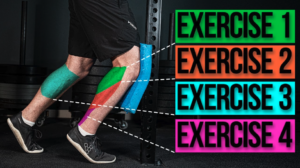
To see the exact movement demonstrations, exercise setups, and anatomical walkthroughs from this guide, check out the full video breakdown here.