


The inverted row might be one of the most effective and versatile back exercises available. It allows you to train every muscle in your back, can be performed virtually anywhere, and can be customized to target specific muscle groups depending on your goals.
Want to take your training up a notch?
Use promo code SAVE10 to get 10% off any program right now. https://citizenathletics.com
Learn more about our training at the bottom.
How to Set Up and Perform the Inverted Row
The execution is straightforward and hard to mess up when approached correctly:
- Find an anchor: Grab onto something hanging.
- Set your body: Pop up and get into position.
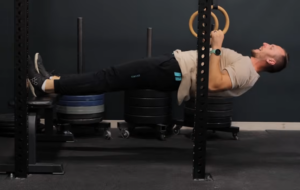
- Initiate the movement: Pull your body up toward the anchor points.
While the movement is simple, form breakdown is still common. To get the most out of the exercise, you need to avoid three frequent mistakes.
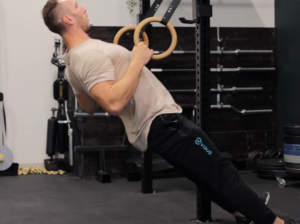
3 Common Inverted Row Mistakes to Avoid
1. Curling the Upper Back
Many lifters set up and focus solely on pulling themselves up, leading to a rounded upper back.
- The fix: Since the goal is to strengthen the back, get nice and tall, keep your chest up, and pull with your back in a proud chest position.
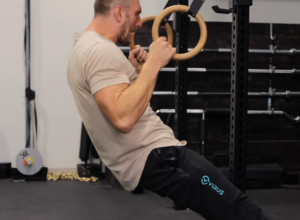
2. Reaching the Head Forward
Poking your chin or head forward toward the anchor points provides no training benefit.
- The fix: Keep your face back and maintain a neutral head position throughout the pull.
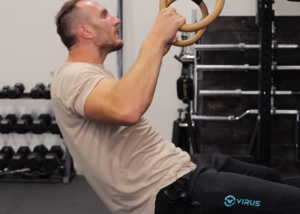
3. Humping the Air (Excessive Hip Movement)
Using momentum or thrusting your hips upward takes tension away from where it belongs.
- The fix: Keep your hips straight and locked in. While the hips are working statically to keep your body rigid, they are not the primary mover, the focus must remain on pulling with your back.
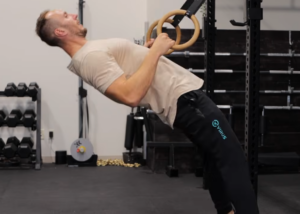
Proper Scapular Mechanics: Moving the Shoulder Blades
To build and strengthen your back, your shoulder blades must move in coordination with your arms:
- Bottom position: Hang long with arms straight, allowing the shoulders to move forward.
- Concentric pull: Drive your shoulder blades back and elbows back as you pull your chest up.
How to Adjust Intensity and Body Angle
You can modify the exercise’s difficulty using four adjustments:
- Strap/Line Length:
- Tighten (shorten) it to make the movement easier.
- Lengthen it to make it harder.
- Foot Position & Body Angle:
- Walk your body further under the anchor point to increase difficulty; step back to decrease it.
- Bending the Knees (Regression):
- If straight legs are too difficult, bend your knees to shorten the lever and decrease the load.
- Elevating the Feet (Progression):
- If standard rows become too easy, elevate your feet on an elevated surface to increase the challenge.
Customizing Arm Angles, Grip Width, and Hand Rotation
The inverted row can be adapted to hit different parts of the back by tweaking your setup:
1. Arm Angles
By changing the angle of your arms relative to your torso, you can emphasize different musculature:
- Lats
- Mid back
- Upper back
2. Grip Width
Vary your setup width to challenge your back differently:
- Narrow grip
- Medium grip
- Wide grip
3. Hand Rotation
If you are using free-hanging equipment like rings, you can switch between:
- Overhand (pronated)
- Underhand (supinated)
- In-between / neutral rotation
Equipment Options: How to Do Inverted Rows Anywhere
You do not strictly need suspension rings to train this movement. You can perform inverted rows with:
- A barbell set inside a rack
- Equalizers or parallel bars
- A bed sheet secured in a door
- Ratchet straps
- Inside a car (though it may be cramped)
There is no excuse to skip back training, the inverted row can be adapted to almost any setting.

Ready to Level Up Your Training?
If you are looking for structured, evidence-based strength and conditioning routines that take the guesswork out of your progress, check out our training programs at Citizen Athletics:
- Built for Athletics: Our premium training system engineered to optimize raw strength, power, and high-level movement efficiency.
- Sustainable Strength: The ultimate flagship framework designed for busy individuals looking to lift heavy, build muscle, and remain highly athletic for life.
Watch the Movement Breakdown
To see these setups, cues, and execution demonstrations in action, watch the complete breakdown here.