

Pull-ups are notoriously difficult, and most people train them poorly. If you want to increase your pull-up numbers and build serious pulling strength, you have to put in the work with a structured exercise progression.
When watching people perform pull-ups, people generally fall into three categories:
- The fighters: Those who fight, fight, fight, and go nowhere, demonstrating real grit.
- The kippers: Those who can’t do them strictly, so they kip and turn the pull-up from a predominantly back exercise into a full-body exercise.
- The crushers: Those who crush pull-ups.
To turn the first two categories into crushers, you need to build strict strength for pull-ups through a precise, progressive overload framework.
Want to take your training up a notch?
Use promo code SAVE10 to get 10% off any program right now. https://citizenathletics.com
Learn more about our training at the bottom.
The Pull-Up Exercise Progression Parameters
To get pull-ups, you have to follow a strict progression model based on the following training parameters:
- Exercise 1: 4 sets of max reps (start here until you can hit 4 sets of 12 reps).
- Exercise 2: 4 sets of max reps (progress until you can hit 4 sets of 10 reps).
- Exercise 3: 4 sets of max reps (progress until you can hit 4 sets of 8 reps).
- Exercise 4: 4 sets of max reps (progress until you can hit 4 sets of 6 reps).
- Crush Pull-Ups: Once you master the final progression, you are ready to crush unassisted pull-ups.
Program Rules
Before diving into the exercises, you must follow three foundational rules:
- Full Range of Motion (Elbows & Shoulders): A common struggle is failing the bottom range (fully extended arms) and the top range. Maximize training through the full range so you are ready when you get there. Elbows must fully open with full extension and full elbow flexion. Shoulders must fully open at the top and come all the way down, fully retracted and depressed at the bottom.
- No Kipping or Momentum: We are building strict strength for pull-ups, so you must keep them strict without using your legs or hips to assist the movement.
- Pause at Top and Bottom: Pause at the top and bottom of every single rep. This reinforces your full range of motion, ensures your elbows are extended and shoulders open at the bottom, ensures your shoulders are retracted and elbows flexed at the top, and prevents you from swinging or using momentum.
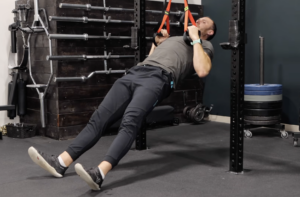
Exercise 1: The Inverted Row
The first exercise in our progression is the inverted row.
- Setup: Hang off a suspension trainer or bar with your hips and knees extended, arms straight, and shoulders open.
- Execution: Pull up nice and high, pause, come back down, and repeat for all your reps.
- Standard for Progression: Emphasize getting horizontal (in line with the floor) at the bottom position. This signifies that you have developed enough strength across all repetitions at that level to move to the next exercise.
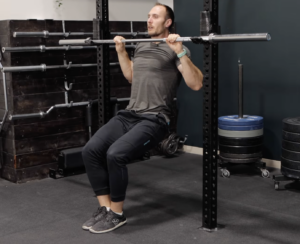
Exercise 2: Seated Pull-Up with Leg Assistance
The second exercise in the progression is the seated pull-up with leg assistance. You will need a barbell in a rack, a TRX, or another setup.
- Setup: Get seated underneath the bar high enough that you can get your arms extended while still able to reach and grip. Bring your feet in nice and tight to keep you vertical and minimize using them.
- Execution: Pull while thinking about using your legs only enough to get up. Act like they are not there and you are not having them help you.
- Benefits: This provides assistance while deloading some of the weight that you normally experience because your feet aren’t hanging off the ground.
- Progression: Over time, you can progress this by elevating your feet to further deload weight before moving to the next step.
Exercise 3: Pull-Up with One-Leg Assistance
The third exercise in the progression is the pull-up with one leg assistance.
- Setup: Set up off a pull-up bar or rings. Place one foot on a box (or bench) that allows you to push through the full range of motion as needed. Come into a full hang with your other leg out, maintaining a vertical torso.
- Execution: Start pulling, getting those shoulders down and back, pausing at the top for good control, and coming down nice and slow to a full bottom position with elbows and shoulders open.
- Goal: While you could use your leg, the goal is to have it slightly assist you and mostly deload body weight instead of actively pushing. Focus on pulling as hard as you can with your lats and arms.

Exercise 4: Eccentric Pull-Up with Leg Assistance on the Way Up
The final exercise in our progression is the eccentric pull-up with leg assistance on the way up.
- Setup: Set up the same way with one leg down on a bench for assistance on the way up.
- Execution: Pull up while minimizing the use of your leg, then let that leg off and lower slowly.
- Tempo: The goal is to lower over a 4 to 6-second count. Do not just drop. If you performed the prior exercise well by minimizing leg usage on the way up, you will be prepared to control this eccentric phase.
- Progression: Once you can get through all your reps here without relying heavily on your leg on the way up, take the leg away and move to your first set of unassisted pull-ups.

A Final Note on Body Weight
Pull-ups are a bodyweight exercise. If you are an individual with a higher body weight, you may want to consider losing some weight if pull-ups are your primary goal. Getting stronger at all these pulling movements is helpful, but having a high body weight means you will face more resistance on a bodyweight movement. Lowering your body weight makes the movement more accessible.
Train Smarter with Citizen Athletics
Executing training protocols with proper intensity and structure is the difference between spinning your wheels and seeing genuine physiological adaptations. If you want structured, evidence-based strength and conditioning programs that take the guesswork out of your training, explore our programs at Citizen Athletics.
- Built for Athletics: Our premium training system engineered to optimize raw strength, power, and high-level movement efficiency.
- Sustainable Strength: The ultimate flagship framework designed for busy individuals looking to lift heavy, build muscle, and remain highly athletic for life.
Watch the Technical Breakdown
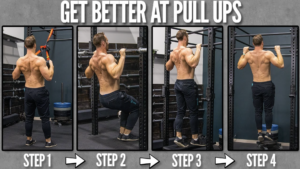
Want to see these movements performed with exact form? Watch the full technical breakdown and visual walkthrough here.