

The glutes have become one of the most popular muscle groups to train. People typically prioritize glute training for three main reasons: lower body physique aesthetics, sporting performance (generating force in multiple directions), and managing various aches and pains.
However, many lifters fail to see meaningful progress due to poor exercise selection, flawed execution, and a lack of understanding of biomechanics. To determine the most effective exercises, we must look directly at functional glute anatomy, regional subdivisions, leverage, and load vectors.
Want to take your training up a notch?
Use promo code SAVE10 to get 10% off any program right now. https://citizenathletics.com
Learn more about our training at the bottom.
Functional Glute Anatomy and Regional Subdivisions
The glute complex consists of three distinct muscles:
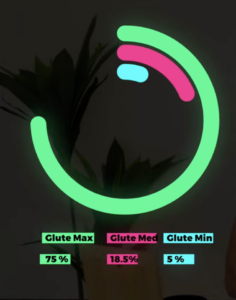
- Gluteus Maximus: The largest muscle in the human body, accounting for roughly 75% of total glute volume. It originates along the ilium and sacrum on the posterior side of the pelvis, running laterally and downward to insert into the femur’s gluteal tuberosity and the IT band. Together, these attachments allow the glute max to produce hip extension, hip abduction, and hip external rotation.
- Upper Glute Max: Contributes to all three motions, but primarily functions in hip abduction and hip external rotation.
- Lower Glute Max: Minimally assists with abduction and external rotation, serving primarily as a powerful hip extensor.
- Gluteus Medius: Accounts for approximately 18.5% of glute volume. It originates on the lateral ilium and runs in a fan shape downward to the femur’s greater trochanter. It primarily produces hip abduction, with secondary contributions to hip extension, flexion, internal rotation, and external rotation depending on the region:
- Anterior Glute Medius: Assists with hip flexion and internal rotation.
- Middle Glute Medius: Works alongside all regions for hip abduction.
- Posterior Glute Medius: Assists with hip extension and external rotation.
- Gluteus Minimus: Makes up 5% to 8% of total glute volume. Because it is thoroughly stimulated during hip abduction and compound training, it does not require isolated targeting.
Matching Exercise Profiles to Muscle Leverage
Muscle function is not simply about whether an exercise moves through an action; it is about when a muscle has the best leverage compared to other muscles:
- Hip Extension: The gluteus maximus possesses its greatest mechanical leverage over other hip extensors toward full hip extension (the shortened position).
- Hip External Rotation: Challenging the muscle near its end-range of motion produces the greatest glute max recruitment.
- Hip Abduction: The glutes work best toward the end range of motion (peak abduction), rather than near adduction.
- Glute Medius Bias: Because the upper glute max overlaps in function, isolating the glute medius is best achieved in a hip-extended position with slight internal rotation to minimize tensor fasciae latae (TFL) contribution.
Bilateral Glute Exercises: Squats, Hip Thrusts, and Sumo Deadlifts
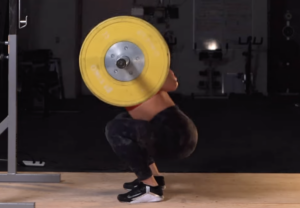
The Squat: Depth Dictates Glute Growth
The squat is often viewed as the primary glute exercise, leading to the phrase “squat for a butt.” Research from Kubo et al. (2019) demonstrated that 10 weeks of squatting produced an average 6.7% increase in gluteus maximus volume.
- Full Squats vs. Half Squats: Deep squats resulted in roughly three times more glute growth than shallow half squats.
- Limitation: Squats place immense demand on the quadriceps and adductors. For lifters seeking dedicated glute hypertrophy without accumulating excessive quad fatigue, squats alone are not the most targeted primary builder.
The Barbell Hip Thrust: Peak Shortened Loading
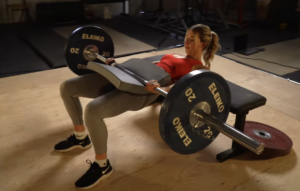
The hip thrust yields the highest compound electromyography (EMG) readings for the glutes and consistently drives glute hypertrophy. To maximize its mechanics:
- Bench Height: Use a stable bench or box positioned roughly level with the bottom of your kneecap (typically 14 to 16 inches for most individuals). If the bench is too high, elevate your feet and hips.
- Hip Protection: Use a thick squat pad or Airex pad across the hips to tolerate heavier loads.
- Pelvic Mechanics: Drive the hips upward by performing a mini-crunch, think about pulling your belt buckle toward your chin to enforce posterior pelvic tilt and full hip extension.
- Shin Angle: Maintain a vertical shin at the top of the movement. Research by Garcia et al. (2020) showed that placing feet too far forward shifts the workload away from the glutes and onto the hamstrings.
- Stance Width & Rotation: A slightly wider stance with toes flared out optimizes the angled fiber orientation of the glute max and medius for higher recruitment.
- Alternative: A standard floor barbell glute bridge works well if bench setup is unavailable.
The Sumo Deadlift: Abduction and External Rotation
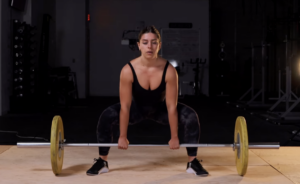
While all deadlift variations challenge the glutes, the sumo deadlift places the hips into greater hip abduction and external rotation.
- Foot Stance: Use a wider stance to reach end-range abduction.
- Toe Angle: Flare the toes outward to challenge hip external rotation through a larger range.
- Deficits: Elevate your feet on plates or use smaller diameter plates to increase hip flexion depth and load the glutes in a stretched position.
Unilateral Glute Exercises
Bilateral lifts provide raw loading potential, but unilateral exercises require the glutes to work hard to maintain the pelvis position side to side and rotationally:
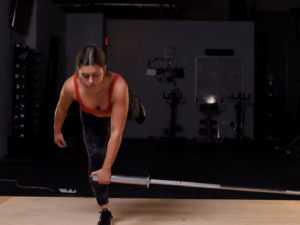
- Landmine Single-Leg Deadlift (Perpendicular Setup): Standing perpendicular to a landmine bar forces the glutes to resist rotational torque across the body while maintaining pelvic alignment.
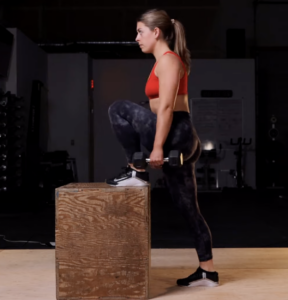
- High Step-Ups: Higher step-ups place high demands on the glute complex. When the rear foot leaves the floor, the glute must forcefully prevent the contralateral hip from dropping. Load this with a pair of dumbbells.
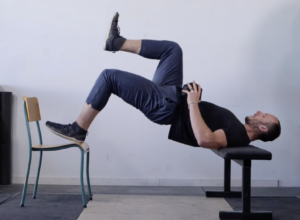
- Single-Leg Hip Thrust (Deficit): Incorporating a deficit allows the working hip to move through a deeper stretch and longer range of motion. Load this with a dumbbell or barbell across the lap.
Targeted Abduction and External Rotation Movements
Compound lifts primarily challenge hip extension. To fully develop the glute complex, dedicated abduction and external rotation work must be added.
Pure Hip Abduction
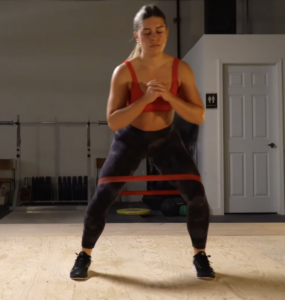
- Banded Lateral Side-Stepping:
- Drive the knees outward continuously; do not allow them to collapse inward.
- Keep the toes pointed directly forward to prevent the TFL from taking over.
- Maintain a level pelvis and height without bobbing up and down, which shifts tension to the quads.
- Progression: Start with the band around the knees, advance to the ankles, and move to the forefeet/toes for maximum difficulty.
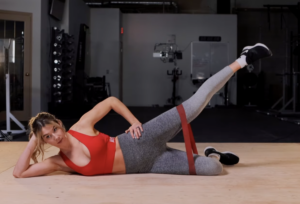
- Side-Lying Hip Abduction:
- Keep the knee straight and toes pointed straight ahead for pure abduction.
- Drive movement entirely from the hip joint, avoiding lumbar lateral flexion (hip hiking).
- Follow the same band progression: knees, ankles, then toes.
Pure Hip External Rotation
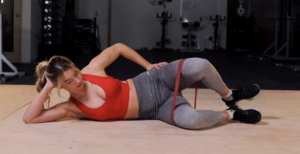
- Three-Position Clamshell: Clamshells are traditionally performed at 45 degrees of hip flexion. Because glute fibers run in diverse directions, rotate through three angles as a high-rep burnout:
- Extended hip clamshell (0° flexion)
- Standard clamshell (45° flexion)
- Deep hip flexion clamshell (90° flexion)
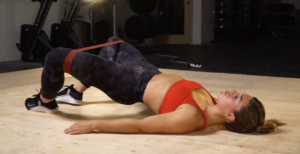
- Supine Banded External Rotation: Lying on your back with a band looped around the knees, drive the thighs outward.
- Can be performed with hips resting flat on the ground or held in a static bridge/extended position to combine peak glute extension with external rotation.
Programming: Bret Contreras’ Rule of Thirds
Knowing which exercises to pick is only half the battle; structuring volume, effort, and vectors dictates long-term results. Glute specialist Bret Contreras organizes training using the Rule of Thirds:
1. Vector Distribution
- 1/3 Horizontal Movements: Exercises like hip thrusts and glute bridges (peak tension in full extension; lower systemic fatigue).
- 1/3 Vertical Movements: Exercises like squats, deadlifts, and step-ups (peak stretch under load; higher systemic fatigue).
- 1/3 Lateral / Rotational Movements: Exercises like banded side-steps, side-lying abductions, and clamshells.
2. Proximity to Failure
- 1/3 Taken to Absolute Failure: Pushing sets until no further clean reps are possible.
- 1/3 Stopped 1–2 Reps Shy of Failure: Hard working sets with controlled technical reserve.
- 1/3 Submaximal / High-Rep Sets: Stopping roughly 3–5 reps short of true failure, commonly used on high-rep pump work without burning out the nervous system.
3. Load Ranges
- 1/3 Heavy Sets: Lower rep, high-tension loading (if preferred and tolerated).
- 1/3 Moderate Sets: Standard hypertrophy rep ranges.
- 1/3 Light Sets: High-repetition sets focusing on burn and metabolic stress.
Note on Exercise Matching: Not every movement suits heavy loads. Exercises like cable pull-throughs or lunges break down into balance struggles when pushed too heavy, whereas hip thrusts and leg presses accommodate heavy loads safely. Horizontal and lateral movements also create less systemic fatigue and muscle damage than heavy lunges or deadlifts, allowing you to handle more total weekly training volume.
Train With Citizen Athletics
Maximizing glute development requires balancing biomechanics, intelligent exercise variations, and fatigue management.
To take the guesswork out of your programming and build functional lower body strength backed by sports science, explore our evidence based routines:
- Built for Athletics: Our premium training system engineered to optimize raw strength, power, and high-level movement efficiency.
- Sustainable Strength: The ultimate flagship framework designed for busy individuals looking to lift heavy, build muscle, and remain highly athletic for life.
Watch the Scientific Breakdown
To see the demonstrations, biomechanical illustrations, and full interview with Bret Contreras, check out the video here.