

Is it better to use low reps, medium reps, or high reps to build muscle?
If you talk to a strength athlete like a powerlifter, strongman, or weightlifter, you will be told that you must hit low reps to build thick muscles. In contrast, if you talk to most bodybuilders, you will hear that higher reps are best to develop a dense muscle.
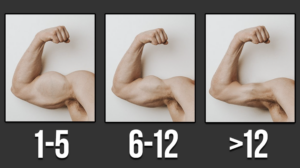
Traditional training textbooks and magazines frequently present a simple rep continuum:
- Strength: 1 to 5 reps
- Hypertrophy (Muscle Building): 6 to 12 reps
- Endurance: Greater than 12 reps
While this neat division sounds simple, current research shows it is actually incorrect.
Want to take your training up a notch?
Use promo code SAVE10 to get 10% off any program right now. https://citizenathletics.com
Learn more about our training at the bottom.
Redefining the Rep Continuum: Understanding the Overlap
Our current scientific research reveals that there is far more overlap between rep ranges than most people think. In general, we can achieve a relatively similar effect for hypertrophy (muscle growth) across most rep ranges.
However, to maximize your training, you must understand three critical considerations from the scientific literature.
1. Proximity to Failure
In the global body of research on muscle growth, how close you train to failure is highly important. To stimulate muscle development, your sets must be reasonably challenging.
This requirement is particularly critical when using lighter weights, as you must create a sufficient level of tension and challenge for the muscle to grow.
- The Rule of Thumb: Aim to be at least within 5 reps of failure for hypertrophy-focused work, especially during isolation exercises.
- The Low-End Cutoff: Extremely low-weight, high-rep sets do not provide as much benefit. The research establishes a recommended cutoff of at least 30% of your 1-repetition maximum (1RM) for hypertrophy. Most trainees naturally lift heavier than this, but it serves as a strict baseline.

Practical Application Across Exercises
Because muscle growth is similar across rep ranges, you can customize your rep selection based on how specific movements feel. Not all exercises feel the same at the same rep counts:
- Large Compound Movements: A set of 12 reps on deadlifts can feel soul-crushing. For these larger movements, you can shy towards the lower end of the numbers.
- Smaller Isolation Movements: A set of 12 reps on biceps curls feels comfortable. For these smaller movements, stick more towards the higher end of the numbers.
2. Training Volume
When it comes to building muscle, volume is huge. The relationship between hypertrophy and volume shows that, generally, more volume results in more muscle growth (though you can do too too much in a session or week and see growth go down).
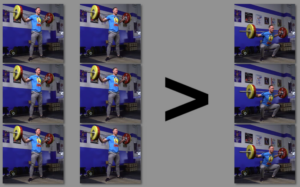
Because low, medium, and high rep sets provide a relatively equal hypertrophy stimulus, muscle building comes down to how many total hard sets you complete. For example, performing 6 sets of squats across a week will result in more hypertrophy than 3 sets, provided both are performed at the same effort level.
The Problem with Extreme Rep Ranges
Factoring in volume is essential because it is incredibly difficult to accumulate enough total sets using only ultra-low or ultra-high repetitions:
- The Issue with Low Reps: Doing singles, doubles, or triples with an appreciable load requires significantly more rest to repeat. It is highly impractical to complete 10 to 20 sets of these per movement in a week.
- The Issue with High Reps: Performing sets of 15+ reps close to failure is brutal. Repeating this for a ton of sets often causes your technique to get sloppy, which decreases the target stimulus and potentially increases your likelihood of injury.
To maximize your volume, you must pick a rep range that matches the movement and allows for high repeatability.
3. Variation and Undulation
While focusing on total hard sets is a primary requirement, research also suggests that varying your set and rep schemes across the week within a program is highly beneficial.
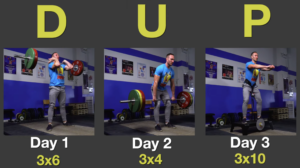
This strategy is widely known as DUP (Daily Undulating Periodization). It involves performing different rep and set counts on different days of the week for movements that challenge the same muscles.
Example of a DUP Weekly Schedule:
- Day 1: Squats – 3 sets of 6 reps
- Day 2: Deadlifts – 3 sets of 4 reps
- Day 3: Belt Squats – 3 sets of 10 reps
Summary: Designing Your Hypertrophy Strategy
Science shows us that there is no magical, single rep range for building muscle size. To summarize the evidence:
- The Ideal Spectrum: Staying somewhere between 3 and 15 reps is ideal for muscle growth.
- Movement Matching: Match your rep range to the specific exercise to ensure excellent technique and high repeatability.
- Effort Level: Ensure your sets are taken somewhat close to failure (within 5 reps).
- Weekly Variety: Vary your reps throughout the week to maximize the total muscle growth stimulus.
Take Your Training to the Next Level
Building muscle requires structured, evidence-based programming that balances volume, proximity to failure, and proper variation. If you need a comprehensive training program designed to help you get stronger, fitter, and feel better, check out the programs we offer at Citizen Athletics:
- Built for Athletics: Our premium training system engineered to optimize raw strength, power, and high-level movement efficiency.
- Sustainable Strength: The ultimate flagship framework designed for busy individuals looking to lift heavy, build muscle, and remain highly athletic for life.
Watch the Scientific Breakdown
If you want to see the complete scientific breakdown, dive deeper into the data, and hear more training tips from Dr. Sam Spinelli, you can watch the full video here.