

Deadlifting is one of the single best ways to build a stronger, more robust back and maximize your posterior chain development. Unfortunately, many lifters are not well-trained on the movement, causing them to miss out on getting the most out of the exercise.
If you already know the basic mechanics but want to pull more weight, optimizing your leverages, muscle recruitment, and programming is key. Here are eight science-backed strategies to increase your deadlift performance fast.
Want to take your training up a notch?
Use promo code SAVE10 to get 10% off any program right now. https://citizenathletics.com
Learn more about our training at the bottom.
1. Get the Bar Back to Optimize Leverage
Deadlifting efficiency is heavily dictated by physics and positions. If you hold a weight against your chest and then push it outward away from your body, it becomes drastically harder to hold. The weight itself does not change, but the demand on your body does.
How hard your muscles must work is determined by torque, which is dictated by force and its distance from the axis. The further out an object moves from the axis, the more torque is created.
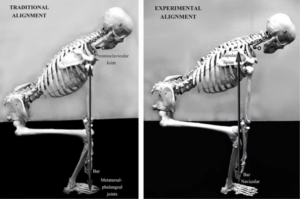
Standard deadlift coaching often instructs lifters to position the bar over the ball of the foot while bent over with straight arms and the tips of the shoulders directly over the bar. While this is not inherently bad, it can be optimized:
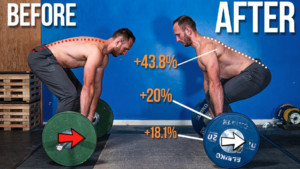
- The Navicular Start: Research (Hancock, 2012) examined shifting the bar further back to start over the navicular bone (the back of your foot’s arch) while positioning the spine of the scapula (shoulder blade) directly over the bar.
- The Result: This technical shift led to a 43.8% reduction in horizontal bar movement.
Minimizing horizontal drift reduces the total loading demand placed on your hip extensors and spinal extensors. Because you are reducing unnecessary mechanical demands without dropping the weight of the barbell, you can realistically add more weight to the bar.
2. ENGAGE Your Lats to Protect Your Spine
Building directly on starting leverages, you must pull the bar tight to your body. In the bottom setup position, focus on keeping your shoulder blades depressed and pulling the bar back flush against your shins.
- Spinal Extension Support: Actively engaging the lats encourages greater spinal extension, which helps manage the heavy mechanical demands of the lift as you fight to pull the bar up.
- Reducing the Moment Arm: Actively using your lats once the plates leave the floor keeps the bar locked back. This shortens the horizontal distance of the weight from your hips and spine.
If you struggle to feel or maintain lat engagement, implement these two training drills:
- Feel the Steel: Stand fully upright holding a barbell. Gradually perform a hip hinge while focusing on keeping the bar rolling directly against your thighs on the way down and the way up.
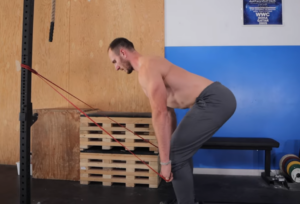
- Banded Hinge Drill: Anchor a resistance band around hip or chest height behind you, loop it around the barbell, step back to create tension, and practice your hip hinge. This setup forces you to actively use your lats to keep the band pulled back through the entire range of motion.
3. Ditch Your Squishy Shoes
Wearing thick, cushioned athletic shoes might look good, but a soft surface elevates your feet and absorbs the force you push into the floor, ultimately leaving pounds off your max lift. Switching to a barefoot setup or a minimalist shoe provides two immediate mechanical advantages:
- Reduced Pulling Distance: You shorten the absolute physical distance the bar has to travel to reach lockout.
- A Stable Base: Research (Julvi Medrano, 2010) demonstrates that establishing a highly stable base of support has a significant positive impact on overall deadlift performance.
4. Strengthen the Bottom Position
Many lifters spend excessive training volume performing rack pulls or block pulls to fix their deadlift. However, data indicates you should prioritize the opposite end of the movement.
- The Power of Mid-Shin Strength: An analysis by Bartolome (2019) looked at isometric strength and the rate of force development at various heights during the deadlift. They discovered that the highest correlation to an individual’s one-repetition maximum (1RM) was strength at the mid-shin position.
- The Weakest Link: This correlates with findings from Beckham (2012), which showed that the bottom position off the floor is the weakest zone for powerlifters generating force.
To maximize your performance, ensure you get a significant portion of your training volume directly off the floor or via deficit deadlifts. When pulling from a deficit, maintain your exact standard pulling position and technique without shifting your mechanics. Take your time entering the bottom position, do not rush the weight, and utilize aggressive leg drive.
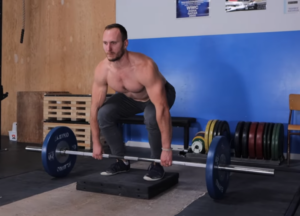
Another highly effective tool is the deadlift to the knees. To perform this, execute only the first portion of the deadlift until the bar reaches knee height, then carefully return it to the ground. This hones your initial leg drive and teaches you to maintain a rigid back angle through the hardest phase of the lift.
5. Build Stronger Hip Extensors
For the vast majority of lifters, the primary sticking point occurs right around the knee. A systematic review (Konf, 2017) confirmed that bar velocity consistently slows down at the knees, making it the most common point of failure.
Once you have built your off-the-floor strength, you must build powerful hip extensors to drive through this mid-point. EMG and kinetic data (Choe, 2018; Martin-Fuentes, 2019) highlight the vital role the glutes and hamstrings play in finishing the lift.
To maximize accessory carries to your main lift, select movements that target these specific tissues based on muscular activation data:
- Stiff-Legged Deadlifts: Martin-Fuentes (2019) noted that the semitendinosus (a portion of the hamstring complex) sees significantly higher activation during stiff-legged deadlifts than most other variations.
- Foot Angle Adjustments: Research by Kawama (2020) analyzed how foot position changes muscle emphasis during the stiff-legged deadlift. Rotating your feet to 20 degrees of external rotation significantly increases biceps femoris activation. Conversely, shifting to 20 degrees of internal rotation shifts higher activation to the semimembranosus.
- Other High-Value Accessories: Deep squats, hip thrusts, and the unilateral (single-leg) deadlift are excellent options. The unilateral deadlift generates incredibly high glute and hamstring activation because isolating a single leg allows you to place maximum emphasis on that working side.
6. Increase Total Training Volume
A common, outdated trend in fitness circles claims that the deadlift is uniquely demanding on the neurological system and therefore cannot handle higher volume. The science says otherwise.
- The Importance of Volume: Research from groups like Colquhoun (2018) demonstrates that making consistent strength progress in the deadlift is heavily dependent on total training volume.
- Manage the Fatigue: If performing heavy volumes of deadlifts drains you, spread your sets across multiple weekly workouts rather than doing them all in a single day.
The Colquhoun data showed no negative difference in strength outcomes based on how frequently people deadlifted throughout the week, provided the total volume matched. Splitting your workload across two to four weekly sessions keeps the movement manageable and prevents severe systemic fatigue.
7. Use Lifting Straps to Overcome Grip Limitations
If your primary goal is to maximize posterior chain hypertrophy and build vertical and horizontal force production, your hands shouldn’t hold your legs back. For non-competitive powerlifters or anyone whose sport doesn’t explicitly ban them, straps offer a major training advantage.
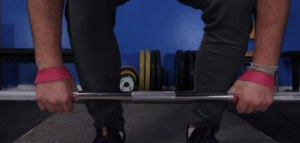
- Instant Force Production: Coswig (2015) tested athletes performing rep max sets at 90% of their 11RM. Utilizing lifting straps resulted in a 20% to 28% increase in force production across the duration of the set.
- Volume Accumulation: Eliminating grip fatigue allows you to safely accumulate more total volume.
A highly practical approach is to perform your heaviest top working sets without straps to preserve raw holding capability, then apply straps to complete all subsequent back-off volume sets.
8. Train Your Grip Separately
While straps are an incredible tool for accumulating volume, grip strength remains a primary bottleneck if left completely ignored. If you are a competitive lifter, straps are banned on the platform, meaning you must be prepared to hold what you can pull. Even for recreational lifters, building a more robust grip ultimately supports heavier loads.
To build your hands and forearms independently without over-fatiguing your primary deadlift sessions, incorporate targeted grip accessories:
- Plate Pinches: Excellent for building thumb and finger pinch strength.
- Suitcase Carries: Heavy, single-sided walking carries that demand high-output forearm and core stability.
Ready to Build a Serious Deadlift?
Implementing these position adjustments, biomechanical principles, and programming strategies will fast-track your strength gains on the platform. If you want structured, science-backed routines designed to take the guesswork out of your training, explore our evidence-based athletic programs.
- Built for Athletics: Our premium training system engineered to optimize raw strength, power, and high-level movement efficiency.
- Sustainable Strength: The ultimate flagship framework designed for busy individuals looking to lift heavy, build muscle, and remain highly athletic for life.
Watch the Full Scientific Breakdown
If you want to see these movement mechanics, lat drills, and lifting positions demonstrated in real-time with visual examples, watch our full video breakdown on YouTube here.