

“How do I get abs?” is one of the most common questions in fitness. Specifically, people want to know how to train their upper abs versus their lower abs. To effectively build these areas, you need to understand the structural differences, exercise mechanics, and what the scientific research actually says.
At Citizen Athletics, we look at the data to determine how to get the most out of your core training. Here is the evidence-based breakdown of how to target your upper and lower abdominal regions.
Want to take your training up a notch?
Use promo code SAVE10 to get 10% off any program right now. https://citizenathletics.com
Learn more about our training at the bottom.
Two Critical Cavets to Keep in Mind
Before diving into core exercises, there are two major principles to establish:
- The Body Fat Threshold: If you have higher amounts of belly fat, your abs will not show regardless of how much you train them. Spot reduction (doing thousands of crunches or sit-ups to burn fat in one specific area) is a myth. Generally, abs do not become visible until body fat reaches a minimum of 15% to 20% for men, and slightly higher for women. To make your abs show, you must focus on nutritional strategies, lifestyle changes, and a proper exercise program to lower your total body fat percentage.
- Isolation is Optional: You do not have to train your abs in isolation to develop them. A study by van den Tillaar et al. compared core activation between a plank with 20% of body weight on the back and a heavy 6-rep max back squat; both movements showed similar rectus abdominis activation. Furthermore, research by Saeterbakken et al. demonstrated that performing compound lifts unilaterally (one-sided) significantly increases rectus abdominis activation. If you are lifting heavy and incorporating unilateral movements, your abs are already getting a decent stimulus. It’s not perfect, but if you’re short on time, direct work MAY not be essential.
Upper vs. Lower Abs: Can You Separate Them?
The short answer is yes and no.
The rectus abdominis (the front ab muscle) is divided into multiple small muscle bellies separated by fascia, and it is innervated by multiple distinct nerves (unlike a muscle like the bicep, which has only one nerve). This unique structure means you cannot completely isolate the upper or lower abs, but you can preference the activation of one region over the other. EMG studies on belly dancers, who can perform a belly roll by moving the upper, mid, and lower abdominal sections separately, confirm this distinct neural control.
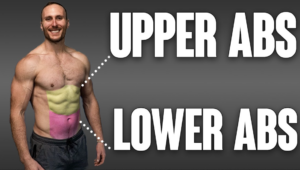
- Upper Abs (Top Two Muscle Bellies): Primarily function to flex the thoracic and lumbar spine, drawing your rib cage down toward your pelvis.
- Lower Abs (Bottom Two Muscle Bellies): Primarily function to posteriorly tilt the pelvis, drawing your pelvis up toward your thoracic spine.
Top Science-Based Upper Ab Exercises
To maximize hypertrophy (muscle growth) in the upper abs, we prioritize isotonic movements (where motion occurs) over static isometrics like planks. Moving through a full range of motion yields better muscle development.
Furthermore, to create a true mechanical challenge, your torso must be reclined or inverted against gravity. Sitting upright and bending forward offers no resistance to the abs.
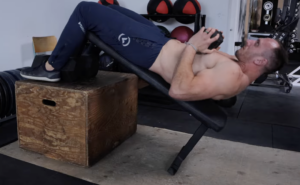
The Top Choice: Weighted Decline Crunch or Sit-Up
Using a decline bench, hook your legs in at the high end, hold a weight plate or dumbbell against your chest for resistance, and curl up.
- Crunch vs. Sit-Up: A minimal-motion crunch preferences the upper abs, while a full sit-up becomes a total abdominal movement. Find a smooth, sweet spot with the decline angle; if it’s too steep you will lose control of the movement, and if it’s too shallow you won’t establish a sufficient challenge.
Highly Effective Alternatives:
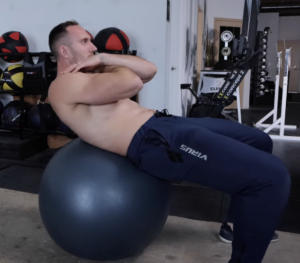
- Ball Crunch: Lie over an exercise ball to allow your spine to go into full extension at the bottom, then curl back up. You can hold a weight at your chest, or hold it straight out and drive it overhead as you crunch.
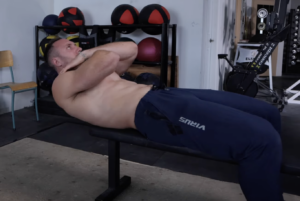
- Bench-Supported Crunch: Sit across a standard bench, secure your legs tightly against the side of the pad, let your shoulders round over the edge into extension, and curl back up.
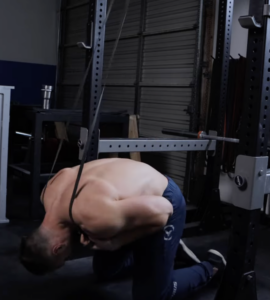
- Cable or Band Crunch: Stand or kneel beneath a high pulley or anchored band, extend tall, and curl downward, driving your forehead toward the ground.
Top Science-Based Lower Ab Exercises
To shift the mechanical leverage to the lower abs, the movement must focus on drawing the knees toward the chest and creating a posterior pelvic tilt. Think of this action as trying to pull your belt buckle up toward your chin. This completely shifts the length-tension relationship in favor of the lower ab bellies.
The Top Choice: Back-Supported Hanging Leg / Knee Raise
The standard hanging leg raise has a major biomechanical flaw: as your legs come up, your entire body shifts backward in space. This reduces the moment arm and decreases how hard the abs have to work (similar to a bicep curl where the elbow drifts backward, removing tension from the bicep).
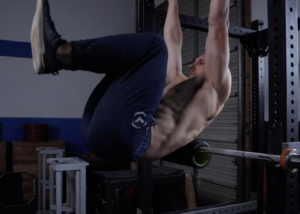
- The Optimal Setup: Set up a padded barbell (using a foam roller around the bar) inside a squat rack at mid-back height. Stand on a bench or box so you can hang safely without jumping, and rest your mid-back firmly against the padded bar. This fixed support prevents your torso from shifting backward. Bring your knees or legs up, using the box to stop your legs at the bottom of each rep to completely eliminate momentum.
Highly Effective Alternatives:
- Incline Bench Knee Tuck: Lie face up on a decline bench, but flip your body around so your head is at the high end holding the handles. Execute a controlled knee tuck from this incline position to maximize lower ab leverage. Avoid letting your legs extend too far straight out at the bottom, as this shifts the workload to your hip flexors instead of your abs.

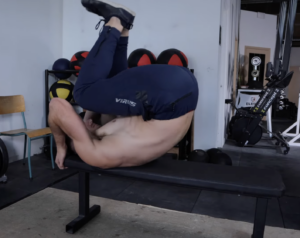
- Standard Reverse Crunch: Perform a reverse crunch lying on a flat bench or on the ground, focusing purely on lifting the pelvis off the floor via a posterior pelvic tilt.
Move, Lift, and Perform Like an Athlete
Building a strong, visible core requires combining strategic exercise selection with structural compound programming. Eliminate the guesswork from your workouts and follow an elite training blueprint engineered by sports performance professionals:
- Built for Athletics: Our premium training system engineered to optimize raw strength, power, and high-level movement efficiency.
- Sustainable Strength: The ultimate flagship framework designed for busy individuals looking to lift heavy, build muscle, and remain highly athletic for life.
Watch the Full Technical Breakdown
To see the exact biomechanical setups, the belly-dancer research context, and proper execution of the pelvic tilt, check out the full video guide here.