


If you want to get stronger, build muscle, burn fat, or improve your fitness, you might think you have to push to your absolute maximum week in and week out. However, grinding until you die isn’t the only way. In fact, some people actually get better results by taking it a bit easier periodically.
A deload is essentially a training phase where we make training easier for about a week. The basic premise is that going easier for a week lets your body recover and catch up from previous weeks of hard training. Normally, we push ourselves to exceed our baseline abilities to increase fitness, build muscle mass, and get stronger. By taking a week where we still train but do not work as hard, we allow our bodies to heal up, feel better, and move better so we can achieve better results in the future.
Want to take your training up a notch?
Use promo code SAVE10 to get 10% off any program right now. https://citizenathletics.com
Learn more about our training at the bottom.
The Theoretical Models Behind Deloading
There are two main models that explain why you might want to consider using a deload.
1. The Supercompensation Model
When we work out, we temporarily decrease our current preparedness. However, given sufficient time to recover, our body returns to baseline and can actually exceed it. This process is known as supercompensation.
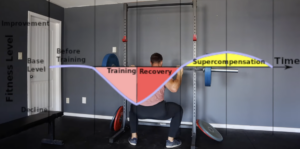
This is a driving principle behind training: we don’t just want to return to where we started; we want to be better off than before. We challenge ourselves with a sufficient stimulus, recover from it, and exceed our previous abilities.
2. The Fitness-Fatigue Model
This model expands on the concept of training by looking at three components: fitness, fatigue, and performance. To improve physical performance, you have two primary options:
- Increase your fitness
- Reduce your fatigue
Increasing fitness requires training hard enough to challenge your body to adapt, build new muscle, and improve your nervous system’s coordination. However, hard training comes at the expense of accumulating fatigue.
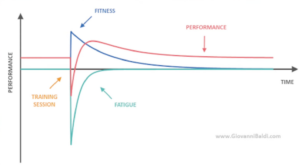
If you continue to train hard and pile up fatigue endlessly, you will eventually exceed your ability to recover and stop making progress. Around this time, it is common to experience a lot of soreness, aches, pains, and injuries.
A deload week introduces a temporary decrease in stress, allowing your body to recover from that accumulated fatigue. Furthermore, if you continuously push yourself through the exact same routine, your body’s responsiveness to that stimulus progressively decreases. Temporarily backing off can increase your responsiveness to that training stimulus when you return to it.
Finally, deloads provide a critical mental break. Pushing hard for weeks can leave you feeling beat up, sore, less motivated, and losing interest in going to the gym.
To summarize, deloads offer three main benefits:
- Increased recovery
- Increased responsiveness to training
- Increased desire to train
What the Research Says About Deloading
To move past theory, we have to look at the actual scientific data. The primary concern most people have is whether taking a deload week will cause them to lose their hard-earned progress.
Does a Deload Make You Go Backwards?
A study by Ogasawara et al. looked at individuals bench pressing three times per week, measuring their muscle cross-sectional area and 1-rep max (1RM).
- Group 1 trained consistently for 24 weeks.
- Group 2 trained for 6 weeks, took a complete 3-week break, and repeated that cycle for 24 weeks.
During the 3-week breaks, Group 2 did experience a slight decrease in muscle size, but it recovered rapidly once they resumed training. By the end of the 24 weeks, the continuous training group had slightly better results, but the difference was very minor and not considered significantly different.
However, stopping training completely for three weeks is not what a proper deload looks like. A study by *Bickel et al.*looked at a more specific protocol. They had individuals perform 27 sets of leg exercises per week for multiple weeks, resulting in increased quad size and strength. They then reduced the training volume by two-thirds, dropping it down to just 9 sets per week.
The researchers monitored them for weeks and found that the participants maintained their size and strength results. This tells us that unless you stop training entirely, you should not go backwards.
Optimizing Deload Volume
To determine how much you should drop your training volume, we can look at two specific papers:
- A meta-analysis by Ralston et al. on weekly set volume identified that performing at least 5 sets per week for a specific movement (like squats or deadlifts) was associated with better long-term results. While training with fewer than 5 sets still produced results, higher volume generally meant more improvements.
- A newer systematic review and meta-analysis showed that performing at least one hard set three times per weekis enough to maintain progress.
A deload week is not designed to make progress; it is designed to recover from the weeks where you pushed hard to make progress. As a real-world example, when training the deadlift twice per week (doing 6 sets on day one and 3 sets on day two), a deload could drop those numbers to 4 sets and 2 sets respectively. This cuts total volume by roughly 30% (retaining 70% of previous volume) while still clearing the 5-set weekly threshold required to maintain progress.
Optimizing Deload Intensity
Volume is only half of the equation; we also have to consider intensity. A 2018 study by Lasevicius investigated responses to different training intensities by having individuals perform unilateral bicep curls and leg presses at 20%, 40%, 60%, and 80% of their 1RM.
The data demonstrated that training at at least 40% of 1RM allowed individuals to make improvements in strength and muscle growth. Across the broader body of research, if you are training with a hard effort and using at least 30% of your 1RM, you are generally going to be able to maintain or make progress.
If your normal training loads are at 60% of your 1RM or higher, dropping your intensity by about 10% for a week will make your training significantly less straining while ensuring you don’t lose ground.
How Long Should a Deload Last?
While standard advice dictates a deload should last one week, a study by Marrier looked at maximizing performance in rugby sevens players at the end of a hard 4-week preseason training camp. The athletes were tested in force, speed, power, and repeated sprint ability (endurance) before entering a multi-week taper phase.
The researchers tested them each week across a 3-week taper:
- Performance generally increased across the board.
- The biggest spike in performance occurred after just the first week of a reduced challenge.
- Performance did not change significantly after that initial week.
This indicates that if you are tapering specifically to maximize performance for a competition, you might benefit from a longer, multi-week deload. However, if your goal is simply to recover from training, feel good, and get back to working out hard, a single week is more than enough.
Summary of Guidelines for an Effective Deload
If you are training hard, following a structured plan with a decent amount of intensity and volume, and feeling like you need to recover, implementing a one-week deload is a smart choice.
To optimize your deload week and maintain your results, apply the following targets:
- Volume: Aim for at least 1 to 2 sets of hard effort three times per week to ensure you stay above the minimum maintenance threshold of roughly 5 total sets per week.
- Intensity: Keep your weights above 30% of your 1-rep max.
- Proximity to Failure: Ensure you are still training with a relatively hard effort, keeping your sets within the 1 to 5 Reps in Reserve (RIR) range.
Using these scientific parameters will significantly lower your physical stress, grant you a much-needed mental break, and fully prepare your body to attack your next phase of training.
Ready to Optimize Your Training?
At Citizen Athletics, we use evidence-based principles to take the guesswork out of your fitness journey. In most of our programs, we build in a small, strategic deload every four weeks to keep your joints healthy, your motivation high, and your body primed for consistent progress.
- Built for Athletics: Our premium training system engineered to optimize raw strength, power, and high-level movement efficiency.
- Sustainable Strength: The ultimate flagship framework designed for busy individuals looking to lift heavy, build muscle, and remain highly athletic for life.
Watch the Full Scientific Breakdown

To learn more about the research surrounding overtraining, fatigue management, and how to structure your recovery, watch our complete video guide here.