

When analyzing why people squat, four main reasons stand out for the vast majority of individuals:
- To increase leg strength.
- For performance benefits, specifically increasing vertical force production for activities like jumping and sprinting.
- To increase muscle mass in the quads, adductors, and glutes.
- To train as a competitive powerlifter.
For three out of those four goals, a strong argument can be made that elevating your heels will lead to better training results. Squatting to a deeper range of motion that you can control well yields greater strength and hypertrophy benefits. However, simply instructing someone to “squat deeper” rarely results in a controlled, clean movement.
Want to take your training up a notch?
Use promo code SAVE10 to get 10% off any program right now. https://citizenathletics.com
Learn more about our training at the bottom.
Common Deep Squat Deviations
Outside of competitive lifters, most individuals struggle to achieve significant squat depth, often stopping at a quarter, half, or parallel depth. When forced to go lower without assistance, three common technical deviations typically occur:
- The “Butt Wink”: This is the posterior rotation of the pelvis that occurs as a lifter reaches the bottom of their range. While not inherently bad, it can detract from specific training goals.
- Excessively Wide and Toed-Out Stance: Many lifters adopt a very wide, turned-out stance to allow the hips to sink deeper while keeping the torso upright. While effective for moving heavy loads or meeting sport-specific depth requirements, widening the stance reduces the direct challenge placed on the quads, shifting the workload over to the adductors and glutes. If your goal is quad development or an inline foot position for athletic movements like sprinting, this setup may work against you.
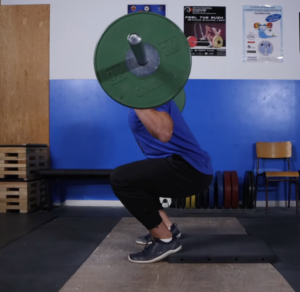
- The “Squat-Morning”: This happens when a lifter descends but leans forward excessively because their knees cannot travel any further forward. The barbell moves lower in space, but the hips are not actually moving down through a true squat range.
How Heel Elevation Solves Squat Mechanics
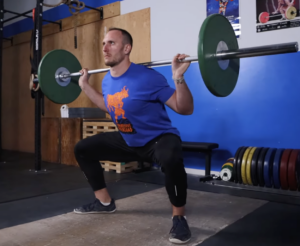
Elevating the heels places the ankles into a starting position of slight plantarflexion compared to a flat-footed, neutral stance. This mechanical shift offers three primary training benefits:
- Increased Forward Knee Travel: Because the ankle starts at a negative angle, the knee can travel forward to its full normal capacity, gaining extra degrees of relative range of motion.
- Quad-Dominant Load Distribution: Elevating the heel translates the entire system slightly forward. This shifts the load distribution in a manner similar to a front squat or a goblet squat, making it significantly easier to target the quads directly and assist lifters who tend to sit too far back.
- Reduced Hip Demand: Utilizing the knees and ankles to a higher degree inherently reduces the relative demand on the hips. This shift regularly alleviates the anterior hip “pinching” sensation or deep structural struggles that many experience at the bottom of a flat squat.
How to Elevate Your Heels Safely
To implement this technique without introducing instability, choose solid, non-compressible options:
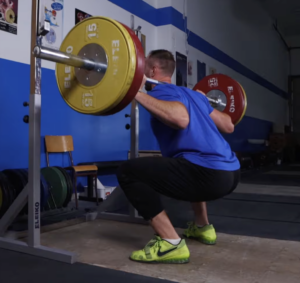
- Heel-Elevated Lifting Shoes: This is the safest, sturdiest, and most consistent option, especially when moving heavier loads. Reputable quality options are produced by brands like Nike, Position USA, and Adidas.
- Sturdy Mats or Ramps: If lifting shoes are outside your budget or goals, utilizing a dedicated wedge or solid mat provides a stable platform.
- Avoid Change Plates: Sliding small weight plates under your heels is an accessible substitute, but it makes finding your foot placement in space difficult during a walk-out. This can lead to inconsistent width and angles from set to set. Never use soft, squishy materials that can compress or slide around under load.
Debunking Common Concerns
Myth 1: “It makes you lose ankle range of motion.”
If you achieve 20 degrees of ankle dorsiflexion in a flat squat and 20 degrees of dorsiflexion in a heels-elevated squat, the joint reaches the exact same end-point. Even if a heel wedge reduces total dorsiflexion demand down to 15 degrees, skipping terminal range in one specific exercise does not automatically erode your mobility. For example, a vertical-shin deadlift does not destroy ankle flexibility. If your objective is strictly to maximize dorsiflexion range, train it directly using targeted movements like calf raises, rather than relying on the squat.
Myth 2: “It is dysfunctional.”
Functionality is defined by how well an exercise matches your desired outcome. If your primary goals are to build quad muscle mass, maximize leg strength, and enhance vertical force production for sprinting and jumping, the heels-elevated squat is highly functional because it maximizes the stimulus required to build those specific traits.
Myth 3: “You won’t learn how to squat properly.”
Flat-footed squatting is a specific motor skill, but it is not a mandatory human requirement unless you are a competitive powerlifter. Real world, non gym movements rarely dictate that your feet remain perfectly flat under heavy load. Just as walking on an incline treadmill does not ruin your ability to walk on flat ground, changing your ankle angle during a squat does not erase your movement baseline.
Note for Competitive Powerlifters: If you compete flat-footed on a platform, your training must remain highly specific as a meet approaches. While heels-elevated squats are excellent in the off-season or as an accessory tool to fix quad weaknesses and torso positioning, you must practice your specific competition pattern closer to test day.
Move, Lift, and Perform Like an Athlete
Building elite leg drive and quad development requires structured programming built on verified biomechanical principles. Stop guessing your setups and take control of your training with our athlete-focused templates:
- Built for Athletics: Our premium program designed to optimize raw power, explosive vertical force, and movement efficiency.
- Sustainable Strength: The ultimate flagship program for busy individuals looking to lift heavy, build muscle, and perform like an athlete on a realistic schedule.
Watch the Full Technical Breakdown
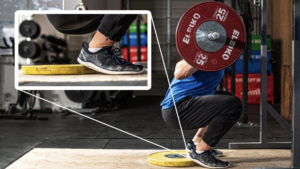
To see these mechanical shifts, stance comparisons, and structural cues in action, watch our complete video breakdown here.