

The chest-supported row is an exceptional upper back accessory movement. It targets the lats, traps, and posterior deltoids to a very high degree. One of its greatest advantages is that it isolates the pulling muscles without overly taxing the spinal erectors, which may already be sore from heavy movements like deadlifts, cleans, or snatches.
How you set up and execute this movement directly dictates the training effect you get.
Want to take your training up a notch?
Use promo code SAVE10 to get 10% off any program right now. https://citizenathletics.com
Learn more about our training at the bottom.
Barbells vs. Dumbbells: Choosing the Right Tool
While you can perform this exercise with a barbell or dumbbells on an incline bench, dumbbells are generally the superior choice.
- The Barbell Setup Issues: A barbell setup can make changing weights difficult because the bench structure blocks you from rolling it easily into place. Furthermore, if the bench is low, plates will hit the floor before you can fully straighten your arms.
- Range of Motion Restrictions: When pulling a barbell, the bar hits the underside of the bench before your muscles reach peak shoulder extension. To pass the midline of your body and get your hands to your ribs, you have to flare your elbows out into a wide grip (or a “snatch grip”). While this works, it shifts the focus to your upper back instead of your lats.
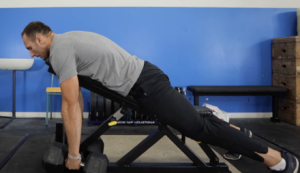
- The Dumbbell Advantage: Dumbbells solve these clearance issues, allowing your hands and elbows to travel past the bench to maximize movement range.
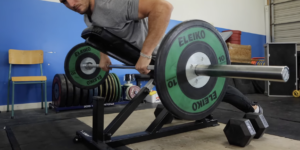
Tweaking Bench Angles to Shift Muscle Focus
The angle of your incline bench alters the line of pull against gravity, shifting the workload between your lats and upper back:
- High Incline (45° or higher): Shifting the bench to a higher angle increases the moment arm for the upper back musculature. It removes the mechanical advantage from the lats, making the upper back work significantly harder.
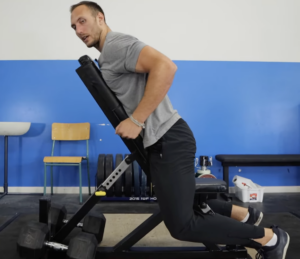
- Low Incline (Around 30°): A lower incline angle maximizes the leverage for your lats. The ideal angle for most people is the lowest incline setting that still allows you to fully straighten your arms at the bottom without the weights hitting the floor.
Optimizing Your Form: Grip, Elbows, and Shoulder Blades
To get the most out of dumbbell chest-supported rows, focus on three primary mechanical details:
1. The Neutral Grip
You can hold dumbbells with an overhand, underhand, or neutral grip. Overhand and underhand grips cause the dumbbells to strike the bench early, cutting your range of motion short. A neutral grip (vertical hands with palms facing each other) allows the weights to clear the bench completely, providing maximal shoulder extension.
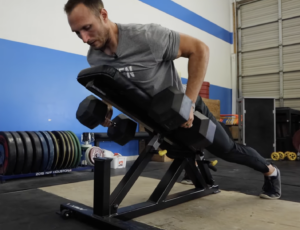
2. Elbow Positioning
- Tucked In: Keeping your elbows close to your sides emphasizes shoulder extension, making it a lat-dominant exercise.
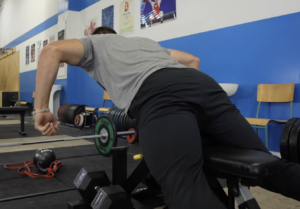
- Flared Out: Flaring your elbows out wider shifts the emphasis to horizontal abduction, heavily targeting the muscles between your shoulder blades.
3. Isotonic Motion (Let the Shoulders Move)
A common question is whether you should lock your shoulder blades back throughout the set. Keeping them pinned turns the movement into an isometric hold for the mid-traps and rhomboids. For optimal strength and hypertrophy, utilize an isotonic motion. Allow your shoulders to protract (stretch forward) at the bottom, and actively retract (squeeze them together) as you pull up.
The Advanced Lat Hack: Adding Bands
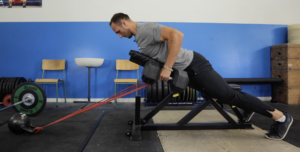
If your primary goal is to build powerful lats, you can add an extra extension challenge by anchoring resistance bands to a sturdy structure (like a dumbbell rack or squat rack) and looping them around the dumbbells.
As you row the dumbbells up and back, the bands create accommodating resistance, forcing the lats to work at their highest capacity at the absolute top of the contraction.
Programming Advice
Because the chest-supported row is highly effective at building back strength safely, it belongs in most training rotations. A solid approach is to program it into a training block once every three to four months before rotating out to other back variations.
Move, Lift, and Perform Like an Athlete
Building an elite back requires intelligent programming that balances heavy compound movements with targeted accessory work. Take the guesswork out of your training with our science-backed training templates:
- Built for Athletics: Our premier program for maximizing raw strength, power, and movement efficiency.
- Sustainable Strength: High-performance training designed to keep you performing like an athlete for life.
Watch the Full Technical Breakdown
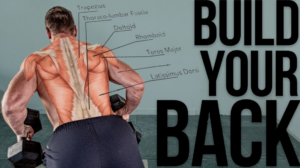
To see these bench angles, grip variations, and the advanced band hack in action, watch our complete tutorial video here.