

What is the “butt wink”? If you’ve spent any time in the lifting community, you’ve likely heard this term whispered with a mix of fear and confusion. Is it a back-breaker? A sign of bad mobility? Or just a natural part of human movement?
At Citizen Athletics, we’re all about cutting through the gym-culture noise with actual science. Today, we’re breaking down what the butt wink actually is, whether you need to fix it, and how to assess your own squat mechanics.
Want to take your training up a notch?
Use promo code SAVE10 to get 10% any program right now. https://citizenathletics.com
Learn more about our training at the bottom.
What Exactly is a “Butt Wink”?
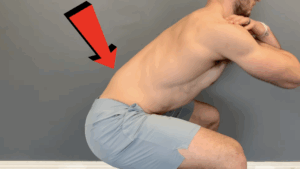
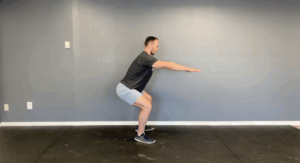
In technical terms, a butt wink is a posterior pelvic tilt that occurs at the bottom of a squat.
As you descend, usually around the point where your thighs are parallel to the ground, your tailbone tucks under and points toward the floor. Because your pelvis and spine are connected, this tilt pulls your lumbar spine (lower back) into flexion (rounding). When you drive back up, the pelvis rotates forward again, and the spine returns to an extended or neutral position.
The common fear is that rounding the spine under load puts undue stress on the lumbar discs, the pars interarticularis, or the SI joint ligaments. But before you panic and cut your squat depth in half, let’s look at the facts.
The Usual Suspect: Are Your Hamstrings to Blame?
The most common advice given to “fix” a butt wink is to stretch your hamstrings. However, in most cases, the hamstrings are not the culprit.
The hamstrings are a two-joint muscle; they cross both the hip and the knee. During a squat, as you descend:
- At the hip: The hamstrings lengthen as the hip flexes.
- At the knee: The hamstrings shorten as the knee bends.
Because these two actions happen simultaneously, the overall length of the hamstring doesn’t change significantly. If you can sit in a chair without your hamstrings limiting you, they likely aren’t what’s causing your pelvis to tuck at the bottom of a squat.
How to Assess Your Squat: 3 Simple Tests
If it’s not the hamstrings, what is it? It could be your hip anatomy, the extensibility of your glutes and adductors, or simply a lack of motor control. Use these tests to find out.
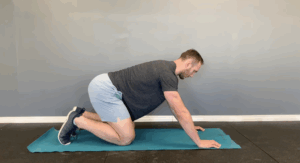
1. The Rock Back Test
Get into a quadruped position (on your hands and knees). Slowly sit your hips back toward your heels while trying to maintain a flat lower back.
- The Result: If you can sit all the way back without your tailbone tucking, you have the physical mobility to squat deep. If your back rounds early, try widening your knees or changing your foot angle to see if a different “path” allows for more depth.
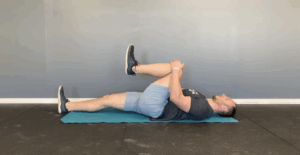
2. The Supine Hug
Lie on your back and pull one knee toward your chest. Keep the knee bent to keep the hamstrings out of the equation.
- The Result: Experiment with the angle. Move your knee toward the midline, then further out toward your armpit. Many people find they can get much deeper with a slightly wider hip angle.
3. The Tempo Squat
If you passed the first two tests but still “wink” during your heavy sets, it’s likely a control issue.
- The Test: Perform a bodyweight squat with a 5–6 second descent. If your form improves when you slow down, you don’t have a mobility restriction, you just need more practice maintaining tension through the full range of motion.
Should You Actually “Fix” It?
Here is the truth: For most people, a small amount of butt wink is not a problem. Recent research suggests that “neutral spine” is a range, not a single fixed point. Our spines naturally move into some flexion during squats, kettlebell swings, and good mornings. If you have no symptoms and your training is progressing, you are likely fine.
However, you might want to address it if:
- It causes pain: If you are “flexion intolerant” and get back pain after squatting.
- It saps your power: Excessive rounding can make it harder to transfer force into the bar, limiting your performance.
4 Strategies to Improve Your Squat
If you want to clean up your technique, try these adjustments:
- Modify Your Stance: Everyone’s hip sockets are shaped differently. Try standing wider, narrower, or turning your toes out more. Find the “slot” where your hips feel most mobile.
- Check Your Starting Position: If you start your squat with a massive “arch” (anterior tilt), you actually run out of hip room faster. Try the “belt buckle to chin” cue: rotate your pelvis slightly back into a neutral position before you start your descent.
- Use a Counterbalance: Holding a 10–25lb plate in front of you (like a Goblet Squat) allows you to stay more upright and sit “into” your hips rather than falling backward.
- Elevate Your Heels: If ankle mobility is your bottleneck, squatting in lifters or with your heels on small plates allows the knees to track further forward, keeping your torso upright and reducing the demand on the hips.
Ready to Train Like an Athlete?
Stop guessing and start following a system designed by experts. Whether you want to maximize your explosive power or just stay strong on a busy schedule, we have a program for you.
- Built for Athletics: designed to build elite strength, power, and movement efficiency.
- Sustainable Strength: The perfect solution for busy people who want to move, lift, and perform like athletes without spending two hours in the gym.
Watch the Full Breakdown

Want to see these tests and cues in action? Watch the full video by Dr. Sam Spinelli here.