


The deadlift is one of the most effective exercises for strengthening your entire posterior chain, including the glutes, hamstrings, and lats. But when performing multiple reps, a common debate arises: Should you come to a complete stop on the ground (deadstop), or just tap and go?
At Citizen Athletics, we look at the biomechanics and research to determine the best approach for your specific goals.
Want to take your training up a notch?
Use promo code SAVE10 to get 10% off any program right now. https://citizenathletics.com
Learn more about our training at the bottom.
The Core Difference
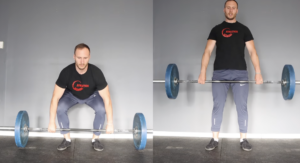
- Deadstop Deadlifts: You lower the bar with control, let it rest completely on the floor, and reset your position before starting the next rep.
- Touch-and-Go Deadlifts: You lower the bar, let it lightly tap the floor, and immediately transition into the next repetition without stopping.
What the Research Says
A 2019 study compared these two methods by analyzing joint angles, ground reaction forces, and the Rate of Perceived Exertion (RPE). The findings highlighted key trade-offs:
- Deadstop deadlifts required more total work per set. They challenged athletes to produce more force from a standstill, leading to a higher net joint impulse and a higher reported RPE.
- Touch-and-go deadlifts were easier to perform with the same weight. They featured faster repetitions and higher ground reaction forces during the upward (concentric) phase, but participants felt less overall exertion.
Which Should You Choose?
For Maximum Strength
If your goal is to pull the heaviest weight possible, deadstop deadlifts are superior. Because every competitive deadlift (and most max-effort attempts) starts from a standstill, training with deadstops develops the specific “starting strength” and technical skill needed for heavy singles. Touch-and-go reps often use slightly different body positioning, which may not translate as well to a true max effort.
For Building Muscle (Hypertrophy)
If you’re training for size, both methods can be effective, but they serve different roles:
- Deadstop creates more total tension and work per rep, theoretically providing a stronger stimulus for growth.
- Touch-and-Go allows you to perform more repetitions or use slightly more weight because the movement is easier, which can help increase total training volume.
The Citizen Athletics Recommendation
For the best balance of safety, strength, and size, we recommend the following guidelines:
- Use Deadstop for sets of 6 reps or fewer to prioritize strength development and perfect technique.
- Consider Touch-and-Go only for higher-rep sets (6+ reps) focused purely on hypertrophy, provided you can maintain control and don’t use the floor to “bounce” the weight back up.
Master Your Deadlift
Whether you’re pulling conventional, sumo, or with a trap bar, your technique should match your goals. Our programs are built on these exact scientific principles to ensure you progress safely.
- Built for Athletics: Master the strength and power required for elite performance.
- Sustainable Strength: Our flagship program for busy people who want to move and perform like athletes for life.
Watch the Full Breakdown

See the biomechanical analysis and the difference in rep speed by watching the full video here.