

The biceps pose is widely recognized as a classic demonstration of health and strength, serving as a prime example of a well-trained, muscular upper body. However, maximizing the development of the upper arms requires a detailed understanding of the underlying anatomy, joint mechanics, and torque profiles of the elbow flexors.
Want to take your training up a notch?
Use promo code SAVE10 to get 10% off any program right now. https://citizenathletics.com
Learn more about our training at the bottom.
Biceps Brachii Anatomy and Joint Functions
The biceps brachii, meaning “two-headed muscle of the arm”, is one of the primary muscles located in the anterior upper arm. It consists of two distinct heads:
- Short Head: Originates on the coracoid process of the shoulder blade.
- Long Head: Originates on the supraglenoid tubercle.
Both heads run down the front of the upper arm, merging into a single muscle belly. They form a shared tendon, the distal biceps tendon, which crosses the elbow joint and inserts into the radial tuberosity of the radius bone in the forearm.
Because the biceps brachii crosses three joints (the shoulder joint and two elbow joints), it executes three primary functions:
- Elbow flexion (bending the elbow)
- Forearm supination (turning the palm upward)
- Assisting in shoulder flexion and abduction (raising the arm overhead)
Muscle Breakdown of the Anterior Upper Arm
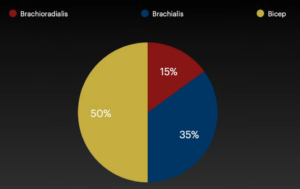
When discussing arm growth, “biceps” typically refers to the collective group of muscles that perform elbow flexion. The biceps brachii actually represents less than half of the overall muscle volume in this region:
- Biceps Brachii: Accounts for 40% to 45% of anterior arm muscle volume.
- Brachialis: Accounts for 30% to 35% of muscle volume.
- Brachioradialis: Accounts for approximately 15% of muscle volume.
Unlike the multi-joint biceps brachii, the brachialis and brachioradialis act primarily as single-joint muscles focused on elbow flexion. Additionally, the brachioradialis assists in forearm rotation in both directions (pronation and supination), depending on the starting position of the forearm.
Biomechanical Factors in Arm Training
To select the most effective exercises for arm growth, three key biomechanical variables must be evaluated: forearm position, shoulder position, and peak torque.
1. Forearm Position and Muscle Recruitment
- Supinated Position (Palms Up): Increases focus and recruitment of the biceps brachii.
- Pronated Position (Palms Down): Increases focus on the brachioradialis.
- Neutral or Variable Position: The brachialis is challenged similarly regardless of forearm position.
2. Shoulder Position and Muscle Length
While research shows the biceps brachii acts primarily as a shoulder joint stabilizer rather than an active primary flexor/abductor, changing shoulder angles significantly alters biceps muscle length:
- Shoulder Extension (Arm behind the body): Places the biceps in a lengthened state.
- Shoulder Flexion (Arm in front of the body): Places the biceps in a shortened state.
Manipulating muscle length is a key driver for stimulating muscle growth across different regions of the muscle.
3. Leverage and Peak Torque Angles
Elbow flexors produce the least force when the arm is completely straight, with leverage increasing as the elbow flexes. However, each muscle achieves its peak torque at a different joint angle:
- Biceps Brachii: Peak torque occurs at approximately 45 degrees of elbow flexion.
- Brachialis: Peak torque occurs in the middle range between 45 and 80 degrees.
- Brachioradialis: Peak torque occurs closer to 80 degrees of elbow flexion.
Exercise loading profiles shift which muscle receives the greatest demand. For example, a band curl creates maximum resistance at the top of the movement, heavily targeting the brachioradialis. A standard dumbbell curl creates peak resistance in the middle range due to the moment arm, providing an even challenge across all three elbow flexors.
Target Exercise Selection by Muscle Group
Best Exercises for the Biceps Brachii
To maximize biceps brachii development, select exercises that maintain or incorporate supination throughout the motion and utilize non-accommodating resistance (dumbbells, barbells, or cables) to load the lower-to-mid range of motion. Rotating shoulder positions ensures complete loading across varying muscle lengths:
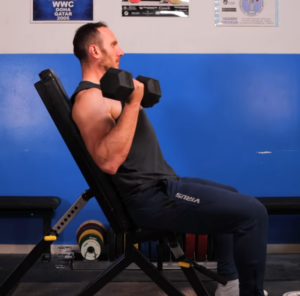
- Incline Dumbbell Curl: Positions the shoulder in extension, targeting the biceps in a lengthened state and emphasizing the long head.
- Preacher Curl: Positions the shoulder in partial flexion, shifting peak torque to the lower portion of the movement to maximize biceps tension.
- Barbell or Rotating Dumbbell Curl: Ensures continuous or dynamic supination under constant load.
Best Exercises for the Brachioradialis
To target the brachioradialis, rely on a pronated grip combined with accommodating resistance to match its peak torque high in the range of motion:
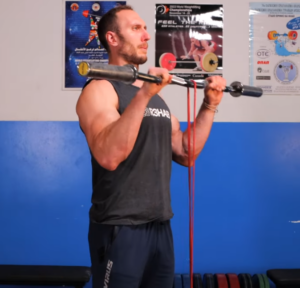
- Reverse Barbell or EZ-Bar Curl with Bands: Combining free weights with band resistance provides resistance throughout the movement while maximizing load at the peak contraction angle near 80 degrees of flexion.
Best Exercises for the Brachialis
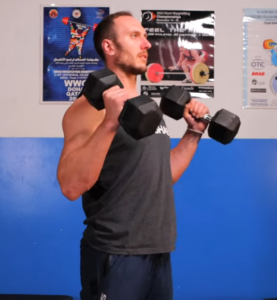
Isolating the brachialis completely is difficult because the biceps brachii and brachioradialis assist in elbow flexion. While a neutral grip (such as hammer curls) increases relative brachialis emphasis, general heavy training with free-weight curls (dumbbell, barbell, or hammer) sufficiently stimulates the brachialis.
Top All-In-One Exercises for Overall Arm Growth
If you prefer a streamlined routine using only one or two movements to fully develop the elbow flexors, the following exercises are the most efficient choices:
- The Zottman Curl
- Execution: Curl the weight up with palms facing up (supinated), rotate the palms down (pronated) at the top, lower the weight slowly under control, and rotate back to palms-up at the bottom.
- Why it Works: It provides a comprehensive challenge in a single rep, targeting the biceps brachii on the concentric phase, the brachioradialis on the eccentric phase, and the brachialis throughout the movement.
- Standard Barbell or Dumbbell Curl
- Execution: Stand tall, curl the weight upward under control, and lower with smooth tempo.
- Why it Works: Offers a simple, reliable resistance profile that loads all three flexors effectively while allowing for straightforward progressive overload over time.
For most individuals performing major compound upper body movements (such as pull-ups and rows), and directly training the biceps once or twice a week with these foundational exercises is more than sufficient for complete development.
Take Your Training to the Next Level
Building complete, science-backed strength requires structured programming tailored to biomechanical principles. Explore our evidence-based training programs at Citizen Athletics to optimize your workouts and build lasting results.
- Built for Athletics: Our premium training system engineered to optimize raw strength, power, and high-level movement efficiency.
- Sustainable Strength: The ultimate flagship framework designed for busy individuals looking to lift heavy, build muscle, and remain highly athletic for life.
Watch the Scientific Breakdown
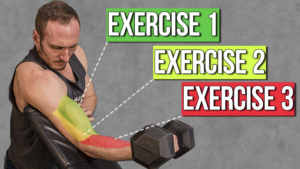
For a complete visual walk-through of the anatomy, leverage angles, and exercise demonstrations covered in this guide, check out the full video breakdown here.