

The vertical jump is the ultimate demonstration of absolute raw power. From the NBA to football and even hockey, it is the measuring stick for an athlete’s explosive ability.
While jumping drills are important, building a foundation of strength is what allows you to produce the massive amounts of force needed to get off the ground. At Citizen Athletics, we focus on high-performance movements that offer the greatest return on investment for your vertical.
Want to take your training up a notch?
Use promo code SAVE10 to get 10% any program right now. https://citizenathletics.com
Learn more about our training at the bottom.
Here are the four essential strength exercises to maximize your vertical jump.
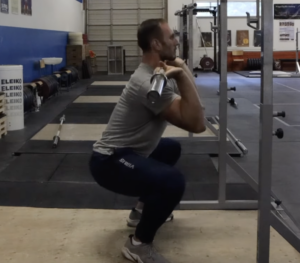
1. The Front-Loaded Squat (Front Squat or Goblet Squat)
Vertical jumping is heavily dependent on the power of your quadriceps. To maximize quad engagement, we prioritize front-loaded squats.
- Why it works: Unlike a back squat, where the hips often shift back, a front-loaded squat keeps the torso more upright. This forces the knees to travel more forward, placing a much higher demand on the anterior thighs (quads).
- Form Tips: Keep your feet flat on the ground and sink as low as you comfortably can to maximize muscle growth.
- Barbell vs. Dumbbell: If you are comfortable with a barbell, the front squat is elite. If you are newer to training or don’t have a bar, the Goblet Squat (holding a dumbbell or kettlebell to your chest) is a fantastic, less technical alternative.
2. The Romanian Deadlift (RDL)
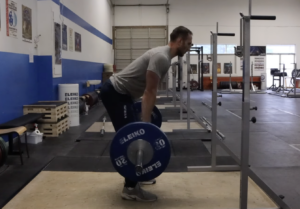
While the quads drive the jump, the glutes and hamstrings provide the necessary explosive “hinge” power.
- The Movement: Whether using a barbell or dumbbells, focus on shifting your hips as far back as possible while maintaining a flat back.
- Form Tips: Keep the weights close to your body to ensure the load stays on your hips and glutes rather than your lower back. Only go down as far as your hamstrings allow without your back rounding, for many, this is just to mid-shin or the top of the knee.
3. The Rear-Foot Elevated (Bulgarian) Split Squat
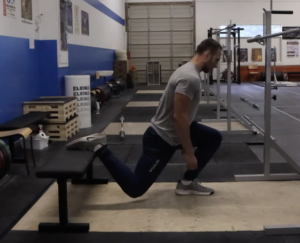
Athleticism rarely happens on two feet simultaneously. This “semi-unilateral” movement is a bridge between bilateral lifting and the single-leg demands of sports.
- Why it works: By elevating your back foot, you place almost the entire load on the front leg. This allows you to train the legs with heavier weights because your back is no longer the limiting factor, as it can be in a traditional squat.
- Form Tips: Allow the front knee to travel forward while keeping the foot flat. A slight forward lean in the torso can help further emphasize that front leg’s power.
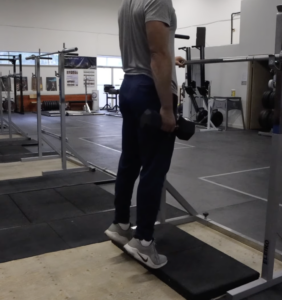
4. The Deficit Double-Leg Calf Raise
While the big muscles of the legs do the heavy lifting, your calves are the final “snap” that transfers that force into the ground.
- The Variation: We recommend the Deficit Calf Raise performed with a slow, controlled tempo on the way down. Using a deficit (letting your heels drop below the level of your toes) improves ankle mobility while strengthening the muscle.
- Form Tips: Keep your knees straight to isolate the calves and avoid “cheating” by using your quads to bounce out of the bottom.
Take Your Vertical to New Heights
Strength is the foundation, but power is the goal. Our training programs are designed to integrate these strength foundations with explosive jumping protocols for maximum results.
- Built for Athletics: Our premier program designed specifically to build the strength, power, and movement efficiency required for elite athleticism.
- Sustainable Strength: The perfect flagship program for busy people who want to perform like athletes and master the basics on a realistic schedule.
Watch the Full Video

Want to see the proper technique and the science behind these vertical jump exercises? Watch the video here.