

Whether you are a new trainee or an experienced lifter, one of the most common questions in the gym is: “How long should I actually rest between sets?”
Old-school bodybuilding wisdom suggested short breaks of 30 to 90 seconds to “maximize the pump.” Meanwhile, powerlifters would often set up chairs in the gym, resting five minutes or more to ensure maximal strength. Even aerobic classes push for as little rest as possible to target fat burning.
But does this conventional wisdom stand up to modern science? At Citizen Athletics, we look at the bird’s-eye view of research to see what actually delivers the best results for muscle gain, strength, and endurance.
Want to take your training up a notch?
Use promo code SAVE10 to get 10% any program right now. https://citizenathletics.com
Learn more about our training at the bottom.
The Myth of the “Pump” vs. Mechanical Tension
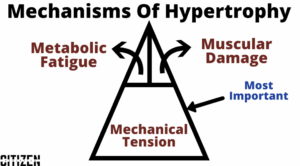
While a short rest break definitely enhances that “pump” feeling (known as metabolic stress), research shows it might not be the most important factor for long-term growth. Hypertrophy is driven by three main mechanisms:
- Mechanical Tension
- Muscular Damage
- Metabolic Stress
Current science suggests that mechanical tension is the primary driver of growth. When we prioritize the “pump” via short rest periods, we often sacrifice the amount of weight we can lift in subsequent sets.
What the Research Says On Rest Intervals
A 2016 study by McKendry et al. compared 1-minute vs. 5-minute rest breaks. They found that myofibrillar protein synthesis, a key indicator of muscle growth, was nearly double in the 5-minute rest group shortly after exercise.
Furthermore, a study by Schoenfeld et al. (2016) found that while both short (1-min) and long (3-min) rest periods led to gains, the group with longer rest breaks saw a significantly greater increase in maximal strength and muscle thickness.
Why Longer Rest Works: The Volume Equation
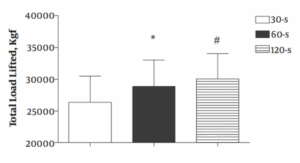
The reason is simple: Volume. Longer rest breaks allow you to handle more overall weight and repetitions across your entire session. Research by Lopes et al. (2018) showed that as rest decreased to 30 seconds, rep speed slowed down and the Rating of Perceived Exertion (RPE) spiked, leading to a drastic drop in total training volume.
Are You Training for Performance?
If you want to maximize every minute you spend in the gym, your programming needs to reflect these scientific principles.
- Built for Athletics: If your goal is to build elite strength, explosive power, and movement efficiency, this program ensures your work-to-rest ratios are optimized for performance.
- Sustainable Strength: Perfect for busy people who want to move, lift, and perform like athletes without spending three hours in the gym. This is our flagship program designed for longevity and results.
Not All Exercises Are Created Equal
Your rest should also depend on the type of movement you are performing:
- Multi-Joint Exercises (e.g., Squats, Deadlifts): These are highly taxing on the system. Research suggests that 5 minutes is ideal for performance, though you can “get away” with 3 minutes without a massive drop-off.
- Single-Joint Exercises (e.g., Bicep Curls, PEC Flys): These produce less systemic fatigue. You can usually cut these down to 2 minutes of rest without compromising your gains.
The Verdict: How Long Should You Rest?
To be pragmatic, here is the science-based rule of thumb for your next workout:
- Aim for at least 3 minutes of rest before repeating the same movement to maximize strength and hypertrophy.
- For isolation or “accessory” work, 2 minutes is generally sufficient.
- For endurance, while short rest helps in the short term to accommodate fatigue, getting stronger (via longer rest) often leads to better long-term endurance outcomes.
Ultimately, your rest should allow you to feel both physiologically and psychologically prepared to tackle the next set with high effort (aiming for an RPE of 6–7 or higher).
Watch the Full Breakdown

For a deeper dive into the citations and specific data mentioned above, watch the full video on our YouTube channel here.