


Many people start working out to build muscle and burn fat by training three days a week. While this frequency can deliver decent results, a common dilemma arises when comparing this routine to individuals who hit the gym five to six days a week. It often appears that higher training frequencies produce superior outcomes, leaving lifters wondering if they should change their schedule.
Rather than relying on opinions, looking at what scientific research demonstrates provides a clear answer on how many days per week you should train.
When comparing two, three, four, five, six, or even seven days of training per week, you get very similar results depending on a few key underlying factors.
Want to take your training up a notch?
Use promo code SAVE10 to get 10% off any program right now. https://citizenathletics.com
Learn more about our training at the bottom.
3 Critical Science-Backed Components of Training Frequency
To understand how workout frequency affects your body, you must evaluate three core variables highlighted by sports science.
1. Weekly Volume
Volume and muscle building are highly related to one another. Typically, the more volume you perform, the more muscle you build (up to a certain point where it becomes negative).
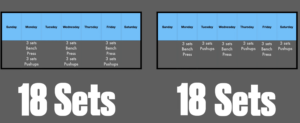
- Muscle Building: Research demonstrates that when weekly volume is equated, training more or fewer days per week does not inherently make much of a difference for building muscle. This is supported by multiple research studies, including Candow and Burke (2007), Schoenfeld (2019), and Dames (2019).
- Strength and Fat Loss: Training more frequently may offer a slight advantage for these specific goals. Colquhoun (2018), Grgic (2018), and Ralston (2018) identified a trend favoring higher frequencies for strength gains. Furthermore, Pina (2020) compared two versus three training days per week; while strength outcomes were very similar at the end of the study, the three-times-per-week group experienced twice the amount of fat loss.
Despite these trends, these differences remain relatively small. If your total weekly volume is equated, you can expect relatively similar results.
2. Average Effort
Maximizing the training stimulus requires paying close attention to the effort exerted during individual sessions.
- To get the best results, you need to train somewhat close to failure on most of your sets.
- A good general cutoff and guideline is staying within five reps of failure.
If you maintain this level of effort consistently across your sessions, your results will remain similar regardless of the number of days you spend in the gym.
3. Minimum Stimulus Per Muscle Group
Most scientific research on this topic evaluates how many times per week you train a specific muscle or movement, rather than just general workouts per week.
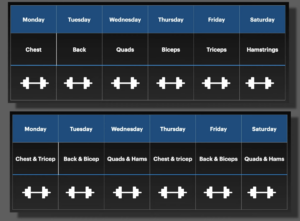
- Traditional “body part splits” that target a muscle only once per week became popular in the 1970s, 80s, and 90s.
- When comparing a once-per-week split to training a muscle group two or three times per week, there is a big difference, with two or more times per week winning out.
- There is a distinct cutoff of at least two times per week per major muscle group to optimize muscle growth.
Training a muscle group even more frequently than twice a week does not inherently bring a massive extra benefit.
Training Experience and In-Session Variables
Your optimal training frequency changes as you progress through different stages of your fitness journey.
- Novice Trainees: Beginners can use less total volume, less effort, and hit muscle groups less frequently while still seeing pretty good results.
- Intermediate Trainees: As you advance, you begin needing more total volume, higher effort, and hitting muscle groups more frequently.
- Advanced Trainees: Advanced lifters need to progress their weights and cycle through distinct volume and intensity phases, while still maintaining the core effort and frequency principles.
Where the specific number of days you train per week starts to change your results comes down to how frequency alters your variables per session:
- Per-Session Volume: For more advanced trainees, four to eight sets per muscle group per session seems to be the sweet spot. Exceeding this amount provides diminishing returns. Additionally, executing too much volume on a single muscle group in one session can hinder your strength and volume capabilities on subsequent days. Spreading your training across a higher weekly frequency reduces this issue and allows you to accommodate more total volume across the week.
- Sustained Effort: Your physical effort naturally begins to diminish as a workout session grows longer. Most people cannot maintain high performance across a massive number of sets in a single workout. A higher weekly frequency allows you to sustain a higher output on each individual set, throughout the entire workout, and across the full training week.
- Individual Variability: Data from research studies shows a wide range of individual responses. Some individuals respond highly positively to high frequency, others thrive on low frequency, and some experience a poor response when switching styles.
Lifestyle and Practical Considerations
Beyond muscle physiology, your daily schedule and personal preferences dictate your ideal setup.
- Length of the Session: If you only have 30 to 45 minutes per day to train, it will be difficult to accumulate enough volume and intensity on a two to three-day weekly schedule if you are past the beginner stage. To get enough volume, you will likely need to train four to five days a week at a minimum.
- Days Per Week You Can Actually Train: If your schedule only allows you to allocate two to four days of training per week, you must perform longer individual sessions to maximize your outcomes instead of short 30 to 45-minute workouts.
- Enjoyment: Fitness is a lifelong focus on your health. If you truly enjoy spending time in the gym, you will likely see better results by splitting up your volume and visiting the gym more frequently. If you do not enjoy going to the gym, you are better off dropping your frequency down slightly to two to four days a week.
There is no single, clear-cut answer that applies to everyone. The best training frequency is an individual choice that accommodates your life, schedule, and personal enjoyment. To maximize your outcomes, monitor your volume, effort, and frequency over time. Progress these variables as needed, and if you hit a plateau, re-examine your setup and use training frequency as a tool to scale your volume and effort.
Achieve Your Fitness Goals with Citizen Athletics
Ready to take the guesswork out of your weekly workout schedule? Check out the evidence-based training programs we offer at Citizen Athletics. Find the perfect program for your lifestyle and start training smarter today.
- Built for Athletics: Our premium training system engineered to optimize raw strength, power, and high-level movement efficiency.
- Sustainable Strength: The ultimate flagship framework designed for busy individuals looking to lift heavy, build muscle, and remain highly athletic for life.
Watch the Scientific Breakdown

If you want to watch the full video analysis covering the research papers, training variables, and data behind these frequency recommendations, check out the complete breakdown here.