

The leg extension machine is a staple tool for isolating the quadriceps. If your training goals require high muscle hypertrophy or specific quad development, isolating the legs through knee extension is incredibly valuable. However, you don’t need access to a traditional commercial machine to get the job done.
Here are 10 highly effective leg extension alternatives and substitutes you can perform at home or in the gym using basic items.
Want to take your training up a notch?
Use promo code SAVE10 to get 10% off any program right now. https://citizenathletics.com
Learn more about our training at the bottom.
Bench-Based Alternatives
If you have a flat or incline bench, you can replicate the exact mechanics of a leg extension machine with a couple of modifications:
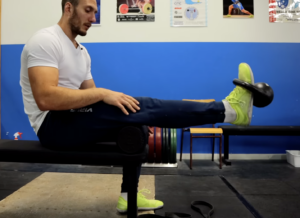
1. Flat Bench with a Kettlebell
Sitting flat on a bench and simply kicking your leg up isn’t challenging enough. To maximize your positioning, place a foam roller underneath your knee. This elevates the joint slightly, mimicking a commercial machine where your hips sit slightly lower than your knees to optimize your leverage. Loop a kettlebell over your toes and kick upward. While it doesn’t provide maximum tension at the very bottom, it offers excellent peak challenge at the top.
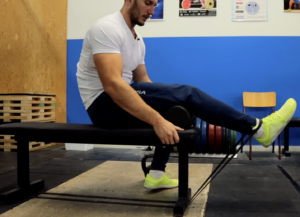
2. Flat Bench with a Long Resistance Band
To introduce steady tension starting from the bottom of the movement, loop a long resistance band around the far side of the bench frame, run it underneath, and wrap it around your ankle. Place a foam roller under your knee and execute the extension. Because of the band’s horizontal angle, the peak tension lands mostly at the top of the rep.
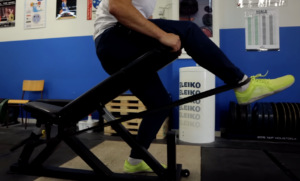
3. Incline Bench Banded Leg Curl / Extension
Set your bench to a slight incline (roughly 30 to 40 degrees; avoid 45 degrees or high inclines). Run a strong resistance band over the top of the bench and get your foot inside. Position yourself facing down the incline. The band will pull your foot low, allowing you to heavily load the lower portion of your knee extension range. Combining the flat bench setup (top range) with the incline bench setup (bottom range) gives you a complete stimulus.
Bodyweight and Floor-Based Alternatives
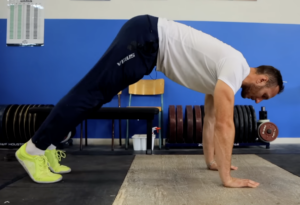
4. Quadruped Leg Extension (Floor or Elevated)
Start on your hands and knees in a quadruped position with your knees bent between 90 and 110 degrees. From here, push off the ground to extend your knees.
- To scale it: You can start with a standard double-leg version, progress to a single-leg version, or loop a resistance band around your knee for extra load.
- To maximize range: Elevate your feet on a bench or box. This allows your knees to sink into deeper degrees of flexion, which is highly beneficial for both quad hypertrophy and joint mobility.
5. Prone Banded Leg Extension
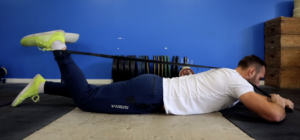
Lay flat on your stomach on the floor. Before laying down, secure a resistance band around your ankle, and run the other end over your shoulder, holding it tightly in your hands. Kick your leg straight against the band’s resistance. This setup is highly challenging through the deeper degrees of knee flexion.
6. Sliding Wall Sissy Squat
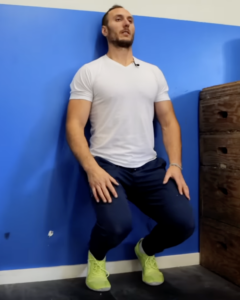
Standard wall sits are static and isometric. To make this an active, isolated quad movement, stand with your toes directly against a wall, elevating your heels as high as possible. Slide down the wall while keeping your torso upright and pushing your knees forward, then kick back up the wall. To make sliding more comfortable, you can use a towel against the wall. Note: If you struggle to keep your feet flat against the base, place a weight plate on the floor slightly off the wall to step on.
7. The Reverse Nordic
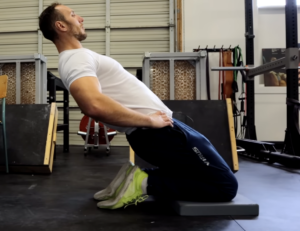
Kneel on a padded mat with your feet flat on the ground and your torso tall. Cross your arms or place them on your hips, then slowly lean your entire body backward as far as you can control before using your quads to kick yourself back to the top. This movement requires a strong isolated knee extension while forcing your trunk to resist hip flexion, making it an elite builder for the rectus femoris muscle.
Banded Standing Progressions
8. Terminal Knee Extension (TKE)
Anchor a resistance band to a rack or post at roughly knee height. Step inside the loop, placing it right behind the crease of your knee, and walk backward to create tension. Start with a bent knee and practice extending it fully by squeezing your quad to drive your heel down.
- Form Correction: A common error is using your glutes to pull your hip back. Ensure you isolate the movement to a contraction of the quad. Because this movement is difficult to load heavily, it is best utilized in initial rehab or warm-up settings.
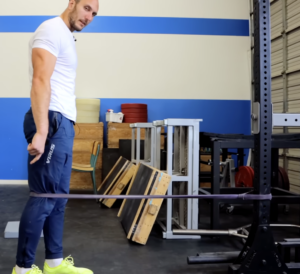
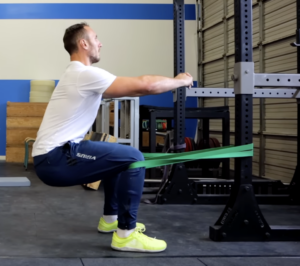
9. The Spanish Squat
To load a standing quad movement much heavier, place a strong band around a rack and loop it behind both knees. Step back until the band pulls your knees forward. Sit back into a squat while fighting to keep your knees pulled back and your torso perfectly upright. Do not lean forward or let your knees shoot forward, as this strips the load off the quads.
Gym Machinery & Weighted Resistance
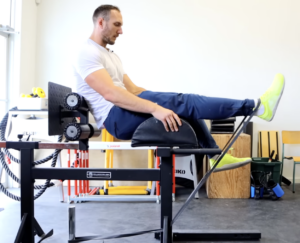
10. GHD Leg Extensions
If your gym doesn’t have a leg extension machine but has a Glute Ham Developer (GHD), you can anchor a resistance band to the frame, sit backward on the pad, loop the band over your ankle, and perform a highly stable leg extension. The GHD provides a solid backrest and a fixed position, meaning your legs won’t move around, which is ideal for isolating a muscle group for pure hypertrophy. (A similar setup can also be executed using a Reverse Hyperextension machine).
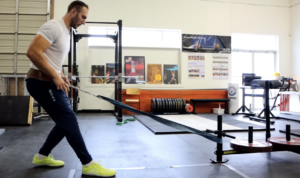
Bonus: Sled Backwards Walking
Sleds are an incredible option for loaded resistance while moving. Attach a weight belt around your waist, hook it to a heavily loaded sled, get low, and walk backward. Each step forces you to sink into a mini leg extension and drive forcefully through your quad to step back.
Move, Lift, and Perform Like an Athlete
True physical longevity requires understanding how to target key muscle groups effectively, even when equipment is limited. Eliminate the guesswork from your leg training and follow a professional, science-backed roadmap built to keep you moving at your highest potential:
- Built for Athletics: Our high-performance training program designed to optimize raw strength, explosive speed, and movement efficiency.
- Sustainable Strength: The ultimate flagship framework engineered for busy people who want to lift heavy, build muscle, and remain athletic for life.
Watch the Full Technical Breakdown
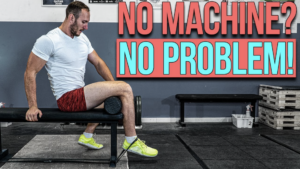
To see the exact band loops, the GHD setup, and the backwards sled dragging technique in motion, check out our full video here.