

Resistance bands are one of the most versatile and cost-effective tools for training at home. Whether you are traveling, stuck without a gym, or just looking to add a different type of mechanical tension to your routine, bands can be a complete game-changer.
At Citizen Athletics, we focus on high-performance training that fits your life. Today, we’re breaking down the best resistance band exercises for every muscle group and the principles you need to actually see results.
Want to take your training up a notch?
Use promo code SAVE10 to get 10% any program right now. https://citizenathletics.com
Learn more about our training at the bottom.
Understanding Your Tools: The 4 Types of Bands
Before diving into the movements, it’s helpful to know which bands work best for which exercises:
- Mini Bands (Loop Bands): Small loops usually placed around the knees, ankles, or wrists. Fabric versions are more durable, while rubber is more cost-effective.
- Tube Bands: These have handles and often come with door anchors, mimicking cable machines.
- Traditional Loop Bands (Jump Stretch Bands): The most versatile option. These long, thick loops can be used for everything from squats to pull-up assistance.
- Therapy Bands: Flat, thin bands often used for light mobility or rehab work.
Lower Body: Building the Engine
Bands are incredible for glute activation and leg strength.
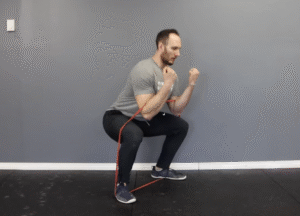
- Mini Band Squats & Lateral Walks: Placing a band around the knees during squats or walking laterally helps engage the hip abductors and glutes.
- Prone Leg Curls: Lie on your stomach with the band around your ankles to target the hamstrings.
- The Zercher Squat: Using a long loop band, hook it under your feet and into the creases of your elbows for a front-loaded squat variation.
- Band Deadlifts & Good Mornings: Step on a long loop band and hinge at the hips to build a powerful posterior chain.
Upper Body: Push, Pull, and Rotate
You can effectively train your chest, back, and shoulders with just a single band.
- Push-Ups: Use a band around your elbows for assistance if you’re building strength, or wrap it across your back for resistance to make the move harder.
- Half-Kneeling Rows: Anchor a band under your front foot and pull back to target the lats and rhomboids.
- No-Money (External Rotation): Hold a mini band with palms up and rotate outwards to strengthen the rotator cuff.
- Overhead Press: Step on the band and press upward to build shoulder stability and strength.
Core and Accessory Work
- Pallof Presses: Anchor the band to a doorway and press forward to resist rotation, building elite core stability.
- Bicep Curls & Tricep Presses: Simple, effective ways to isolate the arms using the constant tension of the band.
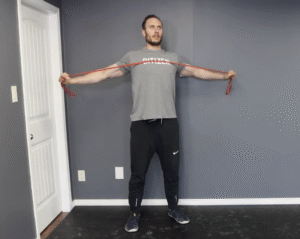
- Band Pull-Aparts: A staple for upper back health and posture.
The Secret to Results: Progressive Overload
The biggest mistake people make with bands is not pushing hard enough. To build muscle and strength, you must reach a high threshold of effort. We recommend training at an RPE of 7 or 8, meaning you should finish your set feeling like you could only have done 2 or 3 more reps.
Consistency is king. If training at home with bands allows you to stay consistent, you will see progress.
Ready to Level Up Your Strength?
Whether you’re training for high-level athletics or sustainable, long-term health, having a plan is the key to progress.
- Looking for Elite Performance? Join Built for Athletics and train like a pro with programs designed for explosive power and speed.
- Want Longevity and Strength? Check out Sustainable Strength, our online subscription program focused on building a resilient body that lasts a lifetime.
Watch the Full Exercise Library
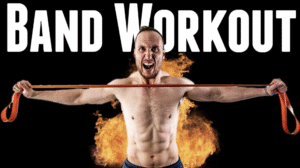
For a visual demonstration of every exercise mentioned above plus more, watch the full video here.