


Most people get their muscle-building advice from the biggest guy in the gym or a flashy fitness magazine. While experience is valuable, it often relies on “bro-science” rather than actual research. If you want to stop wasting time and start maximizing your gains, you need to understand the mechanisms of hypertrophy.
In this guide, we’re diving into the updated science of how muscles actually grow, moving past the myths to the primary drivers of success.
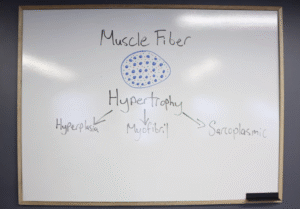
What Exactly is Hypertrophy?
Hypertrophy is a fancy term for “bigger muscles,” but it’s more nuanced than just one process. Research identifies three ways muscle tissue can theoretically change:
- Myofibrillar Hypertrophy: This is where the actual contracting units (myofibrils) within the muscle fiber increase in size or thickness. Think of a rope getting thicker by making each individual strand stronger.
- Sarcoplasmic Hypertrophy: This involves increasing the “other stuff” in the muscle (fluid, glycogen, and proteins). This is what bodybuilders refer to as “muscle fullness.”
- Hyperplasia: This is the idea of adding new muscle fibers. While this has been seen in animals, it has not been proven to occur in humans.
For most of us, myofibrillar and sarcoplasmic hypertrophy occur together as we train.
The 3 Mechanisms of Muscle Growth
Historically, sports science pointed to three distinct drivers of growth. However, modern research has shifted our understanding of which one truly wears the crown.
1. Mechanical Tension (The Primary Driver)
Mechanical tension is the “bee’s knees” of muscle building. It comes in two forms:
- Active Tension: Created when you contract your muscles against resistance (lifting the weight).
- Passive Tension: Created when a muscle is stretched (the bottom of a chest press or a tricep extension).
Pro Tip: By changing your range of motion or the angle of an exercise, you can challenge the muscle with different degrees of tension, signaling different pathways for growth.
2. Muscle Damage
It used to be believed that the “soreness” (damage) you feel after a workout was the main cause of growth. We now know that’s not quite right. While damage occurs, your body spends a lot of energy just repairing what was broken rather than adding new muscle.
3. Metabolic Stress
That “pump” or “burn” you feel during high-rep sets is metabolic stress. While still a factor, researchers now view this as a secondary driver. It’s largely beneficial because it contributes to fatigue, which eventually forces your body to experience more mechanical tension.

The Verdict: Focus on Tension
If you want to build muscle efficiently, everything should circle back to Mechanical Tension. Whether you are using heavy weights for low reps or moderate weights for high reps, the goal is to subject the muscle fibers to enough tension to trigger “Muscle Protein Synthesis,” the process where your body creates new muscle tissue.
Train Smarter, Build Faster
Understanding the biochemistry is the first step. The second step is applying it to a program that actually works. If you’re tired of “guessing” in the gym, check out our science-backed subscriptions:
- Built for Athletics: Designed for those who want to look like a bodybuilder but move like an athlete.
- Sustainable Strength: Our long-term approach to getting strong without the “beatdown” feel of traditional powerlifting.
Watch the Full Science Breakdown

For those who want to see the analogies and research studies in detail, watch the full video here.