

When it comes to building a powerful upper body, vertical pulling movements are non-negotiable. But the age-old debate remains: Chin-up vs. Pull-up. Which one should you be doing? Is one “easier” than the other, or does one build more muscle?
At Citizen Athletics, we focus on movement efficiency and performance. Today, we’re breaking down the science of these two exercises to help you decide which belongs in your program.
Want to take your training up a notch?
Use promo code SAVE10 to get 10% any program right now. https://citizenathletics.com
Learn more about our training at the bottom.
The Fundamental Similarities
Before we look at the differences, it’s important to recognize that both the chin-up and the pull-up are elite multi-joint exercises. Both movements primarily target:
- Latissimus Dorsi (Lats)
- Trapezius and Rhomboids
- Posterior Deltoids
- Biceps Brachii and Brachialis
- Core and Grip Strength
Research shows that the muscle activation for the lats and the erector spinae is remarkably similar between the two. Whether you are pulling overhand or underhand, you are building a strong, functional back.

The Chin-Up: The Bicep Powerhouse
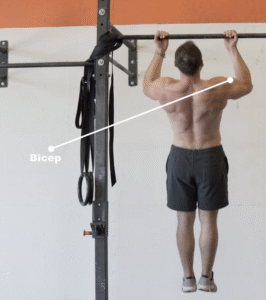
The defining characteristic of the chin-up is the supinated grip (palms facing you).
Because of this hand position, the biceps are placed in a more mechanically advantageous position. This allows the biceps to contribute more significantly to the movement. If your goal is to maximize bicep hypertrophy while training your back, the chin-up is a fantastic choice.
Furthermore, the chin-up involves a slightly different shoulder orientation, emphasizing shoulder extension. For many lifters, this makes the chin-up feel slightly more “natural” or easier to progress initially.
The Pull-Up: The Lat and Forearm Specialist
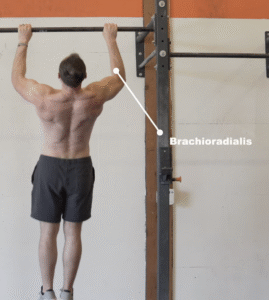
The pull-up utilizes a pronated grip (palms facing away).
By turning the palms away, you decrease the mechanical advantage of the biceps and shift a bit more emphasis onto the brachialis and brachioradialis (forearm muscles).
From a biomechanical standpoint, the pull-up requires more shoulder abduction and scapular retraction. This often leads to a greater sensation of “width” in the lats and increased demand on the lower traps. Because the biceps are less involved, most people find pull-ups more challenging than chin-ups.
Which One Should You Choose?
The “better” exercise depends entirely on your goals:
- Choose Chin-Ups if you want to emphasize bicep growth or if you are working toward your first full bodyweight repetition.
- Choose Pull-Ups if you want to focus on forearm development and specific scapular control.
The Citizen Athletics Verdict: You don’t have to choose. A well-rounded athlete uses both. By rotating these variations, you ensure you’re attacking the muscles from different angles and avoiding overuse injuries.
Take Your Performance to the Next Level
Ready to stop guessing and start training like an athlete? We’ve designed our programs to take the guesswork out of your strength journey.
- Built for Athletics: Our premier program designed specifically to build raw strength, explosive power, and peak movement efficiency.
- Sustainable Strength: The flagship program perfect for busy people who still want to move, lift, and perform like athletes without spending hours in the gym.
Watch the Full Breakdown

Want to see these movements in action? Check out our full video breakdown on YouTube here.